
© FotografiaBasica
Most Sunday afternoons, when I’m driving home from work, I listen to Prairie Home Companion on public radio. For those of you who may never have heard the Prairie Home Companion show, it is an old-time variety show on the radio, created and hosted by Garrison Keillor. Music is a big part of the show (with guests from many genres of music, ranging from country to folk, to blues, bluegrass and gospel), but it also features many comedy skits as well. Some of my favorite skits involve the fictitious sponsors of the show and their commercial breaks sprinkled throughout. One in particular comes from The Catchup Advisory Board (intentionally spelled as a compromise between the two common spellings of the condiment). In these “commercial breaks” we hear from Jim and Barb, an average middle-aged couple with everyday problems. We hear of their recent sufferings and the solution always turns out to be “eat more ketchup” because “ketchup has natural mellowing agents” to solve almost any problem. For instance…
- “Ketchup has natural mellowing agents that help to keep you proactive, not reactive. So you can live your life, instead of destroying your home.”
- “Ketchup contains natural mellowing agents that help you get over the post-holiday blues. And its festive red color really brightens up almost any dish.”
- “Ketchup contains natural mellowing agents that help you remember that you don’t have to take every opportunity to suffer that comes along.”
- “Ketchup has natural mellowing agents that calm your fears and help you look boldly into the future.”
- “Jim… honey… I just wonder if you’re getting enough ketchup. Ketchup contains natural mellowing agents that help you gain perspective on what’s really important.”
And then the commercial ends with the same jingle every time… “Ketchup. For the good times. Ketchup… Ketchuuuupppp.” It always makes me laugh or smile. I guess what makes this skit work is that everyone knows what ketchup is, and consequently how improbable it is that ketchup could really solve any problem. It is a nice thought though.
For many years now, there has been a common debate about whether ketchup or salsa might hold the title of America’s most popular condiment. After doing a little digging, I discovered that total US sales of salsa are indeed higher than those of ketchup. However, the total number of units of ketchup sold exceeds the total number of units of salsa sold in the country. Wrap into that argument the fact that ketchup is cheaper than salsa and also lasts longer in the refrigerator, therefore requiring replacing less often, and I think you’ve got an even bigger debate. Let’s just say, ketchup and salsa are America’s most popular condiments.
What really baffles me about ketchup is its lack of diversity. Let me explain…
Ketchup has been around for centuries, but it didn’t originate as the tomato-based condiment we know today. Ketchup started out as a blend of pickled fish and spices (!). It basically involved mixing something with vinegar, and only started to regularly include tomatoes by the beginning of the 19th century. It wasn’t very well accepted at the time because many people in the 1800s thought that tomatoes were poisonous. They were, however, more inclined to eat tomatoes that had been cooked with vinegar and spices than to eat them raw, so by the last quarter of the century ketchup was accepted and started on its path to becoming one of America’s most popular condiments.
Now, if I were to ask you to picture the bottle of ketchup in your refrigerator right now (and 97% of US households have ketchup in their refrigerator), I’d bet my bottom dollar that you’re probably all picturing the same bottle. Why is that? Ketchup started out as a generic term for a sauce including vinegar, but has ended up as one specific variety of sauce. There is not just one variety of salsa. We choose between mild, medium and hot, between chipotle and tomatillo, between fire-roasted and fresh. Even mustard has varieties that we get to choose from - plain yellow mustard, Dijon, Chinese, whole-grain, and any number of flavored mustards. What happened to ketchup? Where’s our variety and choice? If ketchup is really one of our most popular condiments, why haven’t we embraced its variations?
Well, my friends, now is the time! (you knew this was coming, didn’t you?) Professional chefs are now embracing ketchup’s variations and it’s time for all of us to jump on that bandwagon. At José Andrés’ America Eats Tavern in Washington, DC he serves as many as eight different varieties of house-made ketchup. Restaurants in New York City are serving gourmet ketchups instead of that bottle you just pictured in your head. 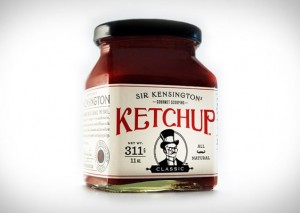 What you’ll find at many of those restaurants is a brand called Sir Kensington’s Gourmet Scooping Ketchup. And it’s delicious! Sir Kensington’s is a little thicker, much tastier, a little reminiscent of salsa, actually. It’s less cloyingly sweet. Why? Because unlike leading brands, it does not contain any high-fructose corn syrup. Instead, it is sweetened with agave nectar, honey and raw brown sugar. Rather than using white vinegar, Sir Kensington’s has apple cider vinegar. In the age of reading the ingredient list, Sir Kensington’s comes out a winner. It has 50% less sugar, 28% less sodium and 25% fewer calories compared to national brands.
I became acquainted with this gourmet ketchup this past year and I’ll tell you why I’m sold on it (aside from the list of ingredients). Previously, my ketchup bottle sat in my fridge for months, unused except for the occasional burger, with a nasty crust around the top of the bottle. Since I started enjoying Sir Kensington’s Gourmet Scooping Ketchup, I’ve gone through three jars! I eat it. I enjoy it. It’s not just for burgers anymore. I’ll tell you a secret… never before have I found myself in the fridge sticking my finger into a jar of ketchup for a little snack! Seriously! Finally, as a cook, I’ve always been a believer that your final product can only be as good as your ingredients, and since ketchup is often used as an ingredient, it had better be good.
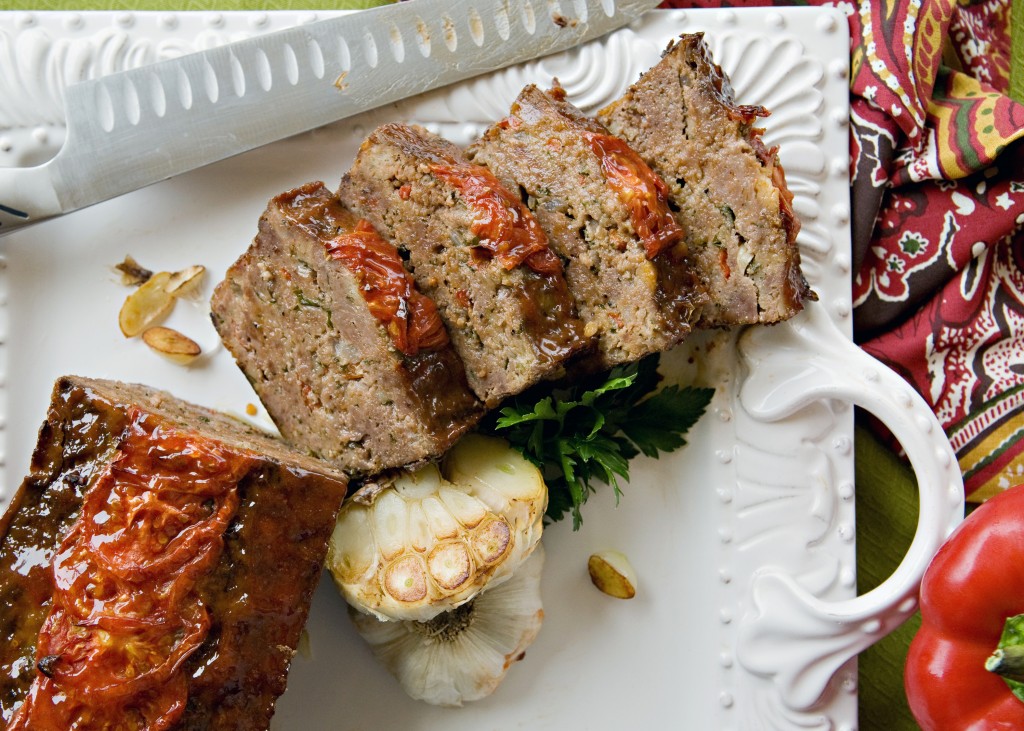
Want to give it a try? You can find it at QVC and I’ll be showing it off on the air on Monday, December 12th in the 4pm ET show. Once you get yours, stick your finger in the jar and give it a taste, spread it on a piece of bread and bite in, or try it on the top of the meatloaf recipe below for the best glaze ever. Now’s the time to embrace The New Ketchup!
Spicy Italian Meatloaf (from Blue Jean Chef: Comfortable in the Kitchen)
photography by Jessica Walker
Serves 8
Ingredients:
- 1 cup fresh breadcrumbs (torn up day old bread is good)
- ½ cup milk
- 2 tablespoons olive oil, divided
- 1 onion, chopped
- 3 cloves garlic, sliced
- 1 pound ground beef
- ½ pound hot Italian sausage, casings removed and meat broken up
- ½ pound sweet Italian sausage, casings removed and meat broken up
- ½ cup chopped roasted red pepper
- ½ teaspoon dried basil
- ½ teaspoon dried oregano
- ¼ cup finely chopped fresh parsley
- 2 eggs
- 1 tablespoon Worcestershire sauce
- 1 teaspoon salt
- ½ teaspoon freshly ground black pepper
- 2 vine-ripened tomatoes, sliced (¼-inch slices)
- 6 tablespoons Sir Kensington’s Gourmet Scooping Ketchup
- 2 tablespoons brown sugar
Directions:
- Pre-heat the oven to 350˚ F.
- Place the breadcrumbs and milk in a large mixing bowl and let the bread soak while you prepare the rest of the ingredients.
- Pre-heat a skillet over medium-high heat. Add 1 tablespoon of olive oil, and cook the onion and garlic until tender but not browned – about 4 to 5 minutes. Transfer the onions and garlic to the bowl with the breadcrumbs and milk.
- Add the ground beef, sausage meat, roasted red pepper, basil, oregano, parsley, eggs, Worcestershire sauce, salt and pepper to the bowl and mix everything together with your hands just until everything is combined. Transfer the mix to a meatloaf pan or baking sheet. If you like a meatloaf with soft sides, leave the mix in the meatloaf pan, ideally one with a perforated bottom and a pan below to catch the drippings. If you prefer a harder crust on the sides of your meatloaf, invert the loaf pan onto a baking sheet and bake the meatloaf without the loaf pan. Overlap the tomato slices on the meatloaf and drizzle the remaining tablespoon of olive oil on top.
- Bake in the oven for 60 minutes. Remove the meatloaf from the oven. Quickly combine the ketchup and brown sugar and brush over the tomatoes to glaze the meatloaf. Return the meatloaf to the oven and bake for 15 more minutes, or until an instant read thermometer registers 160˚ F in the center of the meat. The tomatoes should be roasted and a little brown at the edges. Let the meatloaf rest and then slice and serve.

Great to Ketchup with you!
Pingback: Big Game Wings | BLUE JEAN Chef