
Jan 292012
 

"Be Prepared" etched in a piece of metal


When I was a little girl, my older brother was a boy scout. One day, the scouts were able to bring family members to a meeting and I was invited to go along. I loved every minute of it and promptly decided that I was going to be a boy scout when I grew up too! That, of course, didn’t quite happen - I became a brownie instead - but, the main message of the boy scouts was not lost on me - “Be Prepared”. That’s a good motto and one that I’ve taken to heart.

When I worked as a line cook, whether at the Zuni Café and Café Rouge in California, The Commons in Vermont, L’Oustau de Baumanière and La Cabro D’Or in France, or even Bistro Delight in Kingston, Canada, I would cook for up to 400 people a day (and sometimes I’d spend 6 hours doing it), and being prepared was the only way to accomplish that feat. These days I find that most of the meals I cook are for one or two people, with the occasional dinner party some nights. That’s quite a contrast, but being prepared is still a part of my kitchen life.

Sometimes I really do miss working on a line in a restaurant, but it’s not because I miss the large quantity of food I used to cook. I miss the excitement and the rapid pace of it all and the access to all the equipment and ingredients that comes along with working in a restaurant kitchen - the preparedness of a professional kitchen. One of the easiest ways for me to create a sense of preparedness in my own kitchen at home is to make batches of foods that I can freeze and have at the ready in the future. It’s great to know that you have meals ready to heat up either for yourself, or for spontaneous guests.

The biggest difference between cooking for a few or cooking for a crowd is really just in buying the ingredients. Once you have all the ingredients, it takes almost the same effort and almost the same amount of time whether you make a lot of food or make a little. Most people I know feel that time is their most valued commodity, so with that in mind, it makes sense to cook a lot of food at one time, making lots of meals to save for a day when you have no time at all. It makes sense to “Be Prepared”.

This week, I decided to really value my time and not only made a big batch of food, but also used a pressure cooker to do so, taking one third of the time it would have otherwise taken. Fast AND easy! I made Chicken à la King - basically chicken pot pie without the crust. Making a big batch of this and freezing individual portions lets me have a chicken pot pie any night of the week. All I have to do is heat up my leftovers and just bake off a round of puff pastry or a large biscuit to plop on top. I love being prepared.

Chicken à la King
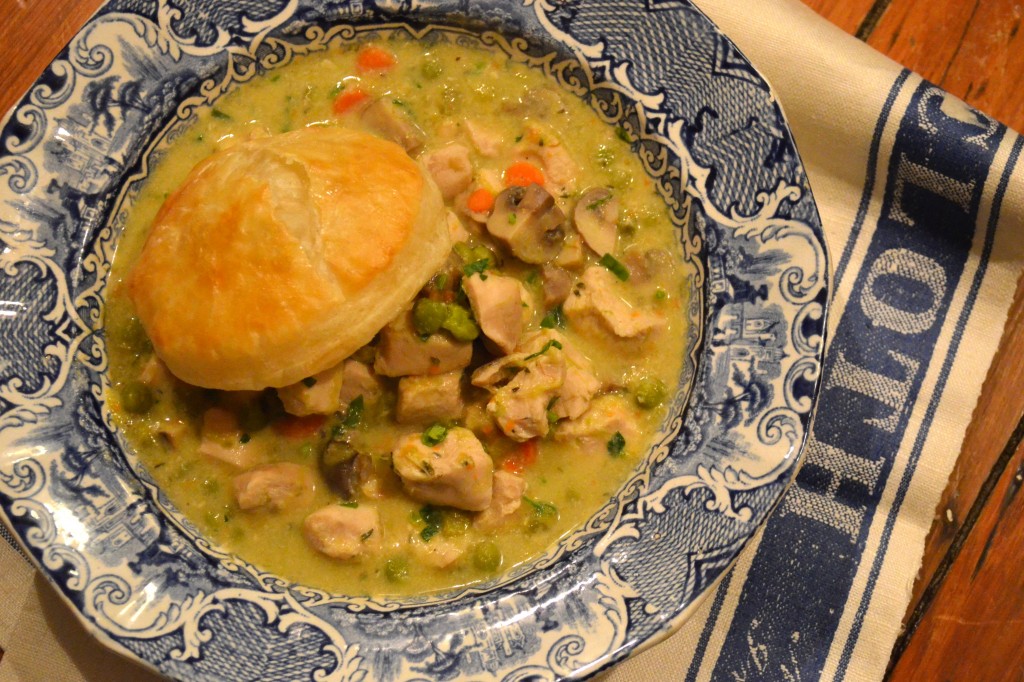
Chicken à la King in a blue willow bowl with a circle of puff pastry on top

Serves 6 to 8

Chicken à la King is basically chicken pot pie without the crust. You can serve this as a pot pie very easily, however, by topping with a circle of baked puff pastry or pouring the chicken over a biscuit. This recipe is easily doubled for a super large batch.

Ingredients:

  • 1 tablespoon olive oil
  • 3 leeks, light green and white parts only, cleaned and sliced into 1-inch slices (or 1 medium onion, small dice)
  • 3 carrots, peeled and sliced ¼-inch thick
  • 3 ribs of celery, sliced ¼-inch thick
  • 3 cloves garlic, minced
  • 8 ounces button mushrooms, quartered
  • 2 bay leaves
  • 1½ teaspoons dried thyme leaf
  • 6 chicken breast halves, skinless, chopped into ½-inch dice
  • 2 cups chicken stock
  • 2 tablespoons butter, room temperature
  • 3 tablespoons flour
  • 2 cups frozen peas
  • ¾ cup half and half (or heavy cream)
  • 1 tablespoon lemon zest
  • 2 teaspoons salt
  • freshly ground black pepper
  • ¼ cup chopped fresh parsley

Directions:

  1. Pre-heat the pressure cooker on the BROWN setting.
  2. Add the olive oil and cook the leeks, carrots, celery and garlic until tender – about 7 minutes.
  3. Add the button mushrooms, bay leaf, thyme and diced chicken to the pressure cooker. Pour in the chicken stock, stir to combine and lock the lid in place.
  4. Pressure cook on HIGH for 8 minutes. While the chicken is cooking, combine the butter and flour into a paste (this is called a beurre manié). Set this aside.
  5. Release the pressure from the pressure cooker manually and carefully remove the lid. Turn the pressure cooker to the BROWN setting and add the frozen peas.
  6. Stir the beurre manié into the pressure cooker ingredients and bring the mixture to a boil to thicken. Turn off the heat. Add the half and half and season with the lemon zest, salt and pepper. Stir in the chopped fresh parsley.
  7. Serve as a stew over mashed potatoes, pasta, or rice; or serve in a bowl with a biscuit or baked circle of puff pastry on top.

Jan 222012
 

close up of BBQ Chicken wings

Confession: I’m not a big fan of football. I watch hockey.

Problem/tragedy: my beloved Montreal Canadiens are doing terribly this year.

Solution/only salvation: take a couple of weeks off from hockey and watch football for the end of its season.

I know so little about football that every year at this time, I have to ask people what teams are still playing. And then I ask them where those teams are from. Here’s what I do know about football:

  • It’s played in the Fall and Winter
  • The season is short because it gets too damn cold to watch it outdoors and for some reason they don’t play indoors even though roofs on stadiums have been around for years.
  • The best HD television cameras are used for football and the graphics are quite amazing - is that yellow line really on the field, and if it’s not, then how can people walk over it like it is?
  • Fans gather several hours beforehand in parking lots and eat food out of the trunks of their cars or off the tailgates of their trucks. Football food includes a lot of finger foods, probably because it’s hard to eat with a knife and fork in a parking lot.

That’s about it.

It’s the last point that makes me think that perhaps I could get into football for a couple of weeks. I love finger food! So, in preparation to watch football, I decided that this pre-game eating was critical to the enjoyment of the sport. I would make some finger food. The quintessential football finger food is, of course, “the wing”.

Traditionally, the wings served in conjunction with football are Buffalo Wings. When I was a little girl in Canada, I thought this was perplexing. What the heck’s a buffalo wing? Buffaloes do not have wings, and yet…(oh boy) Of course, Buffalo wings are not named after the animal, but after Buffalo, New York and refer to a deep fried chicken wing tossed with a butter and hot sauce mixture and served with celery sticks and blue cheese dressing. According to an official proclamation by the city of Buffalo, the Buffalo Wing was invented by Frank Bellissimo in 1964 at the Anchor Bar. However, in reading Calvin Trillin’s account of the history of the Buffalo chicken wing, I once again came across what I’ve always thought about culinary “discoveries” - that they can’t really be pinned down. People have been eating chicken wings for as long as they’ve been eating chickens. Whether it was the Bellissimo’s who first tossed fried chicken wings in hot sauce and butter, or someone else, really can’t ever be known. What can be known is that this preparation of wings became very popular in Buffalo, New York in the 1960s and 70s and Buffalo was credited with the dish. I also read that residents of Buffalo don’t actually call them “Buffalo Wings”, but just wings. (Sort of like the French when they talk about French fries.) I have no first-hand knowledge of whether or not this is true, but it’s believable.

So, as I chose to partake in the football craze leading up to the Super Bowl, I decided to make wings. After all, I’m sure eating the food is part of watching the game. I did not, however, feel like deep-frying, nor did I really want to eat spicy wings that would stain my fingers and create that big red circle around my mouth while my tongue searches for the blue cheese dressing to soothe the burning rage. I wanted a baked wing and I wanted a BBQ flavor. I also wanted a touch of smoke flavor in the wing, as though it was made at a BBQ joint, rather than in my kitchen. I went to work and came up with the Smoky Sir Kensington’s BBQ Chicken Wing recipe that you’ll find below.

The wings were easy easy easy to make and they were delicious and moist. The only trouble with my plan was my timing. I guess I should have made my pre-football game wings on Sunday afternoon, but I made the wings on Saturday night, coincidentally right before Hockey Night in Canada came on TV. Old habits die hard, and of course I watched the Canadiens game. As the playoffs get closer and the chances of Montreal being in those playoffs gets smaller, every night they play is a big game. I ate my wings with the game and the Canadiens won! Maybe there’s something so this pre-game eating after all.

At least now I’m ready for Football’s Big Game when it comes around. When is that?

Smoky Sir Kensington BBQ Wings

Glass bowl of BBQ chicken wings on red and white tea towel

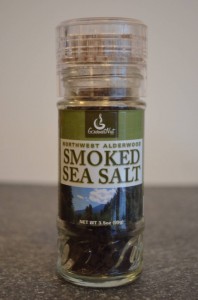
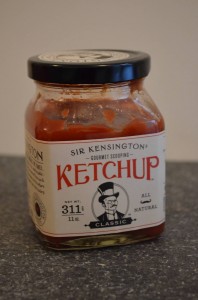
This recipe uses two of my favorite ingredients - Sir Kensington’s ketchup (which you can read all about in a recent post here) and Gourmet Nut’s Smoked Sea Salt (the easiest and most natural way to get a smoky flavor into your foods). I’m a big believer that your finished meal can only be as good as your ingredients, and these ingredients make your finished dish a winner.

Makes about 30 wings

Ingredients:

  • bottle of smoked sea salt with white background3 pounds chicken wings
  • ½ cup all-purpose flour
  • ½ teaspoon smoked sea salt
  • freshly ground black pepper

BBQ Sauce:

  • 1 to 2 teaspoons vegetable oil
  • ¼ cup finely chopped onion
  • 1 clove garlic, minced
  • bottle of Sir Kensington's Gourmet Scooping Ketchup with white background1/8 teaspoon paprika (for a stronger smoky flavor, use smoked paprika)
  • 1/8 teaspoon ground cayenne pepper
  • ½ cup Sir Kensington’s Gourmet Scooping Ketchup
  • 1 tablespoon brown sugar
  • 2 tablespoons apple cider vinegar
  • dash Worcestershire sauce
  • ½ teaspoon smoked sea salt

Directions:

  1. Pre-heat the oven to 400º F.
  2. While the oven pre-heats, make the BBQ sauce. Heat a small saucepan over medium heat. Add the oil and sauté the onion and garlic until translucent (about 5 minutes). Add the paprika and cayenne and stir for about 30 seconds. Add the ketchup, brown sugar, cider vinegar and salt and bring the mixture to a simmer. Simmer for 5 minutes and then remove from the heat and set aside.
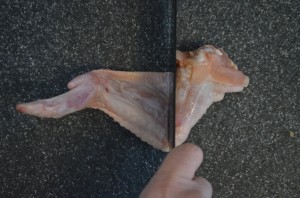
  3. Put the flour, smoked sea salt and black pepper in a zipper sealable plastic bag. Cut the wings into parts, discarding the wing tip and any excess skin.
    a hand holding a knife is cutting the drumette off the chicken wing

    First, cut the drumstick off the wing, cutting close to the meat of the drumstick.

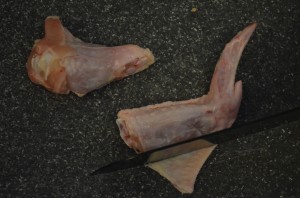
    A knife is cutting away the flap of skin between the drumstick and the "flat" or middle segment of the chicken wing

    Next, cut off the flap of skin between the drumstick and the “flat” or middle segment of the chicken wing.

    Finally, cut the wing tip off the “flat” or middle section.

    In batches, shake the wings around in the bag to dredge them with the flour. Transfer the dredged chicken wings to a baking sheet lined with parchment paper (to make clean up easier) and bake for 20 minutes. Turn the wings over and bake for another 5 minutes.

  4. Transfer the wings to a bowl and toss with the BBQ sauce. Return the coated chicken wings to the baking sheet and cook for another 5 minutes. Remove from the oven and serve.
Jan 152012
 

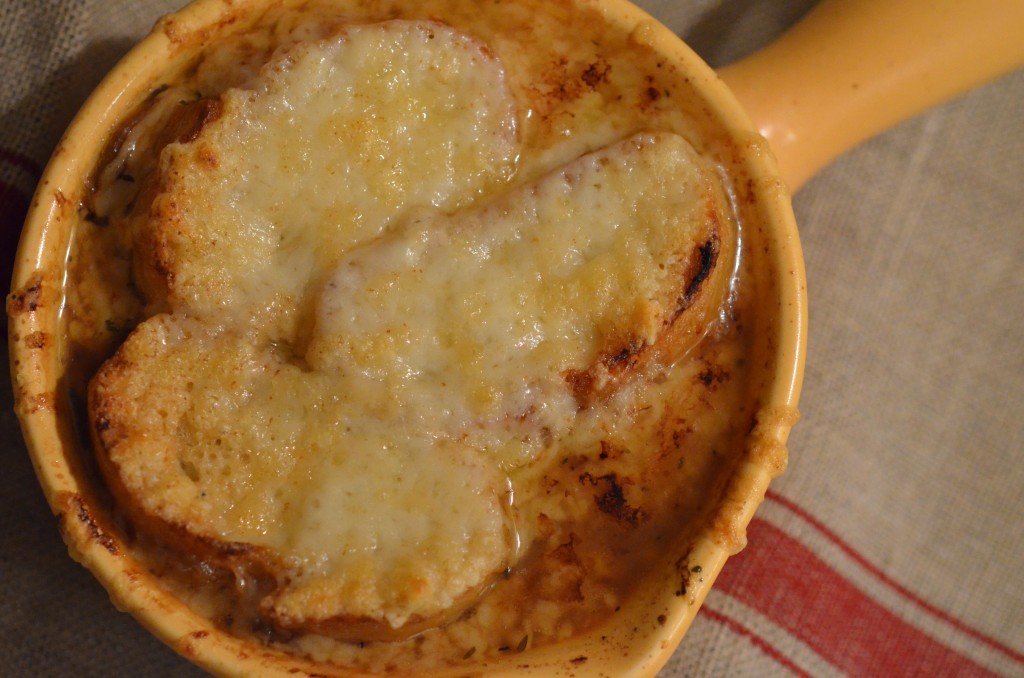
a head on shot straight down into a bowl of french onion soup in a yellow crock

Well, I’m still on my soup kick from last week. In a few months, after weeks of winter, I might be sick of soup and longing grilled dinners, but for now, soup is where it’s at for me. I received several requests for a recipe for French Onion Soup this week, which gave me a craving of my own, so I decided to oblige.

I’ve always liked French Onion Soup. Strangely though, it’s always been something that I’ve ordered out at a restaurant on a cold winter’s night, rather than making it myself at home. When I’ve had it at restaurants, I enjoy the whole bowl, but my favorite part is the gorgeous melted cheese and bread that floats on top, supported by the bed of caramelized onions below. Just the look of a piping hot bowl of French Onion Soup can warm you up and make you feel nourished. The challenge with this ever-so-popular soup, however, comes as soon as you pick up your spoon. It is by far the most difficult soup to eat elegantly. When I made French Onion Soup for myself this week, I was reminded of that as soon as I sat down. How do you break through the bread and cheese crust with only a spoon and without getting soup all over the place (and placemat!). Once through the crust, how many times will you have to wipe burning hot onions from you chin as they slurp off the spoon onto your face?

I pondered these questions while I ate my soup (making a mess and wiping my chin) and decided that the solutions are really quite simple. First of all, after slicing the onions, give them a rough chop to make the slices a little shorter. They will still caramelize beautifully, but they will no longer be as likely to fall from your spoon or lips, scorching your chin. Second, instead of placing one thick slice of bread on top of the soup, make the bread into croutons and scatter them on top, covered with grated cheese. That will make it easier to break through into the soup with a spoon, and eating a cheesy crouton is much easier than trying to manage a massive slab of scalding bread and cheese.

Of course, after a little while, it dawned on me that there is another way to solve the problems of eating French Onion Soup… Slow down. Take a little time to eat dinner and let the soup cool a little from it’s scorching hot, straight-out-from-under-the-broiler state. I’m not one to do many things slowly, but it wouldn’t kill me to take spend some down time over dinner.

French Onion Soup has been around since Roman times, and used to be considered soup for the poor. Onions were easy to grow and inexpensive, so the impoverished would make a soup from onions, topping it with just a piece of bread and cheese. With that reputation, it fell out of favor for many years, but experienced a resurgence in popularity in the United States in the 1960s. It’s a luxurious soup that is still relatively inexpensive to make, but it takes a long time to make and as I figured out, it takes a long time to eat. In our busy lives, it’s not such a bad thing to take the time to make a meal. At least it won’t break the bank.


French Onion Soup

This version of French Onion Soup caramelizes the onions in the oven instead of on the stovetop. It takes a little longer, but you don’t have to spend as much of that time attending the onions while they brown. The critical components of the soup are a very high-quality stock and delicious, nutty Gruyère cheese.

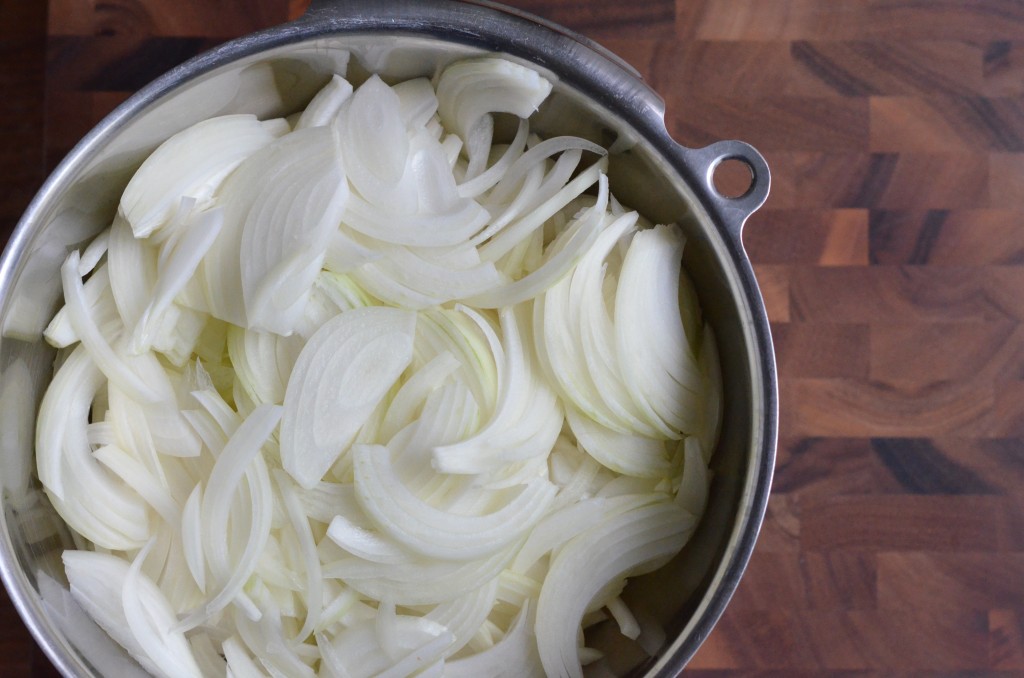
a stainless steel bowl full of sliced onions, resting on a wooden board

Serves 4 (or perhaps 6)

Ingredients:

  • 2 tablespoons olive oil
  • 5 large yellow onions, peeled and sliced lengthwise from stem to root (optional: rough chop once after slicing for shorter lengths of onion in your soup)
  • 2 cloves garlic, peeled and smashed
  • ½ teaspoon dried thyme
  • 2 bay leaves
  • ½ teaspoon brown sugar
  • ½ cup white wine
  • ¼ cup dry sherry
  • 3 to 4 cups low-sodium chicken stock
  • 3 to 4 cups low-sodium beef stock
  • 6 1-inch slices of baguette or other French bread, cut into 1-inch cubes and toasted
  • 6 ounces Gruyère cheese, grated

Directions:

  1. Pre-heat the oven to 350º F and pre-heat a large roasting pan over medium heat.
  2. Add the olive oil, onions, garlic, thyme and bay leaf to the roasting pan and heat until the onions are sizzling.
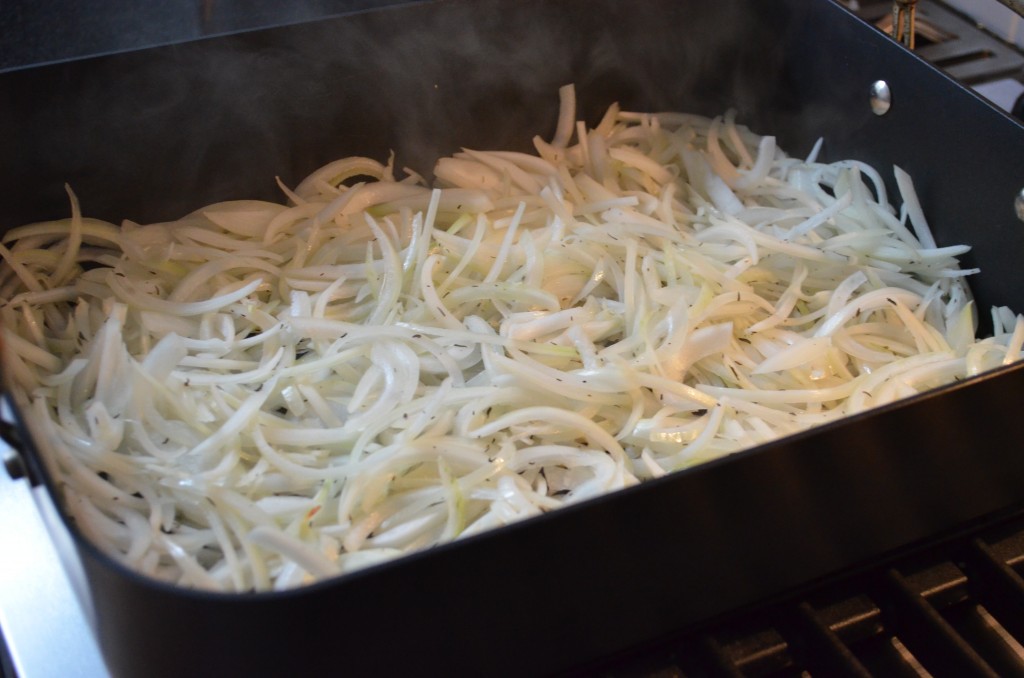
    large hard anodized roasting pan full of onions stewingCut a large piece of parchment paper the size of the roasting pan and press the parchment paper into the pan, pressing down on the onions to cover. Transfer the roasting pan to the oven and let the onions brown slowly for 75 to 90 minutes, stirring with a spatula (to scrape up the bottom) every 20 to 30 minutes.

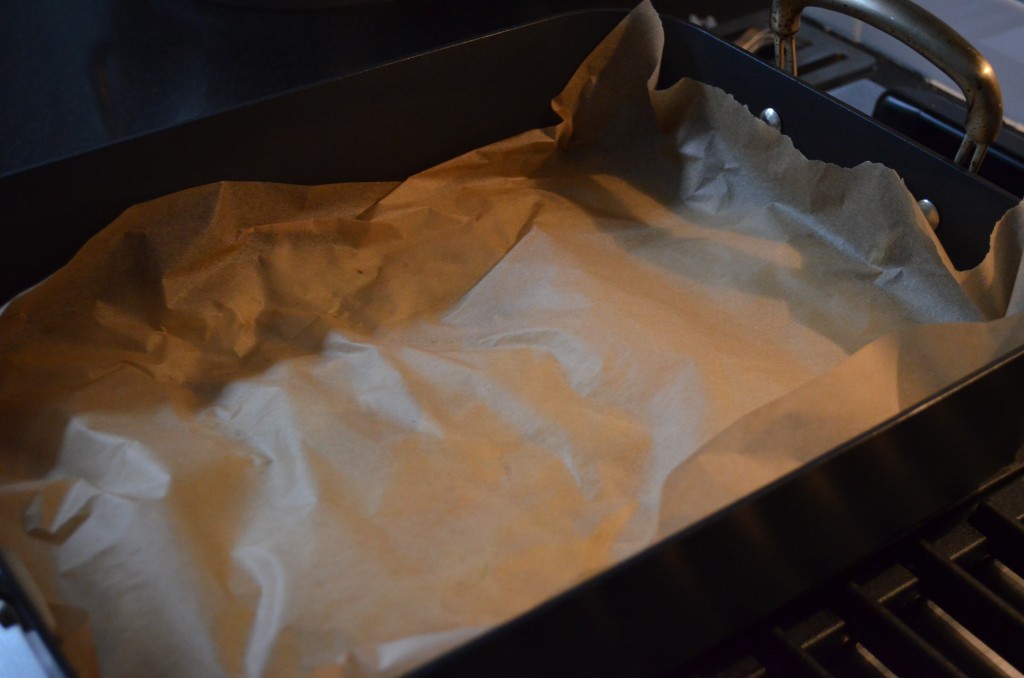
    brown parchment paper pressed down on the onions in a hard anodized roasting pan

  3. Add the brown sugar for the last 15 minutes of cooking and continue until the onions are nicely brown, but not burned. (If the pan seems to get too dark at any time during the process, add a little water or a little of the white wine to the onions, stir and proceed.)
  4. Once the onions are brown, add the white wine and deglaze the pan, scraping up any brown bits on the bottom. At this point, your onions will probably have reduced enough to transfer them to a 4-quart Dutch oven on the stovetop.
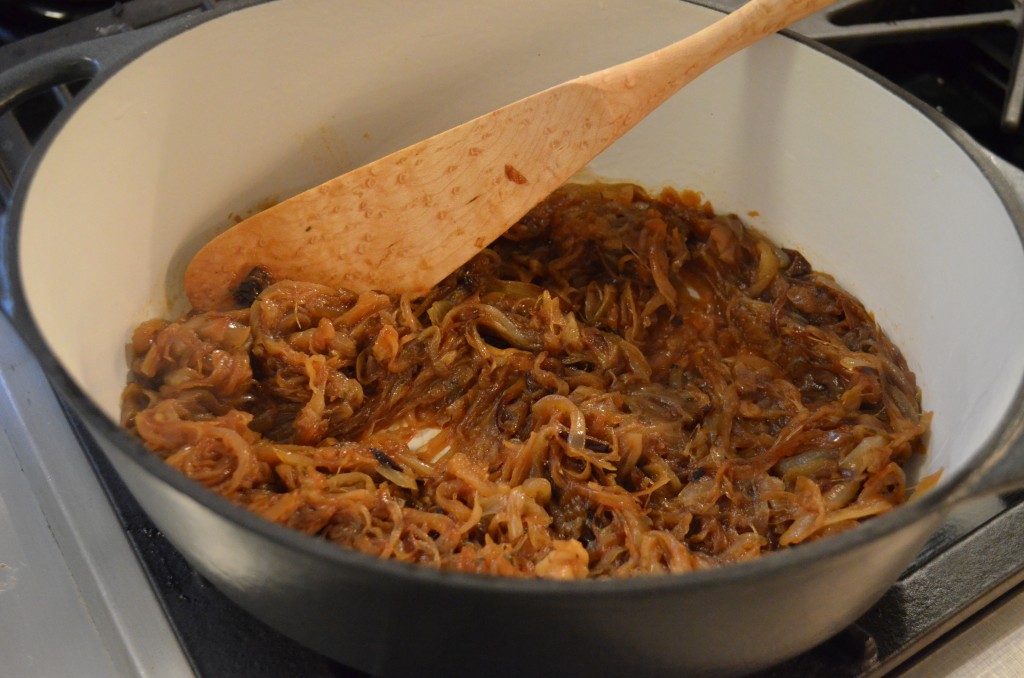
    brown caramelized onions in a cast iron oval pot with wooden spoonAdd the chicken and beef stocks and simmer everything together for about 30 minutes.
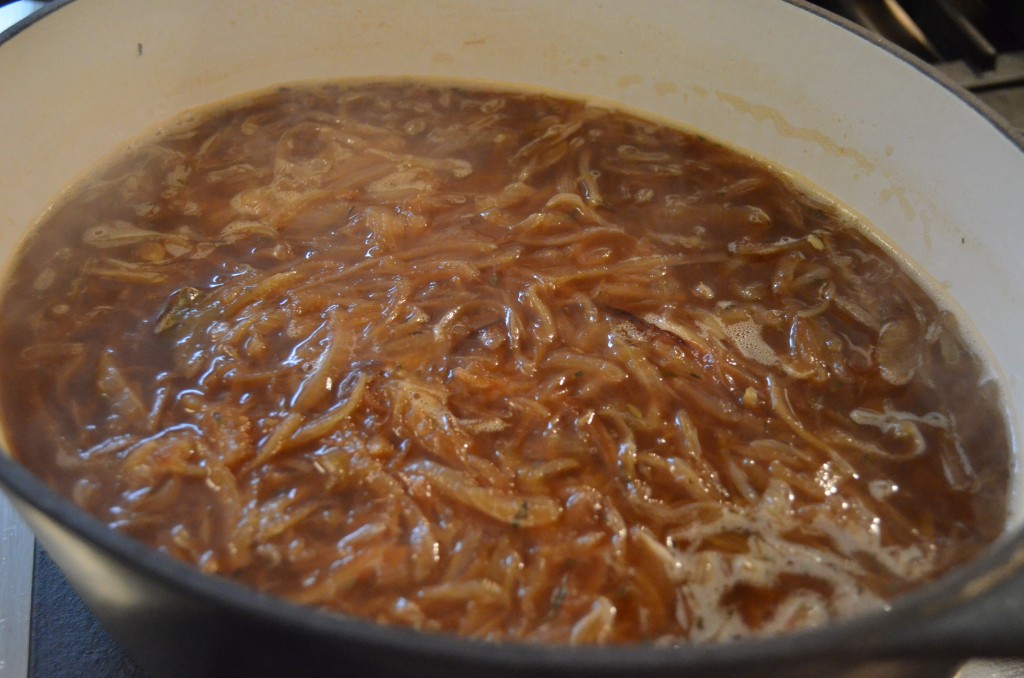
    onions and broth simmering in a cast iron pot
  5. Pre-heat the broiler.
  6. Divide the soup between four soup crocks. Place a handful of toasted baguette croutons on each crock of soup and cover with the grated Gruyère cheese.
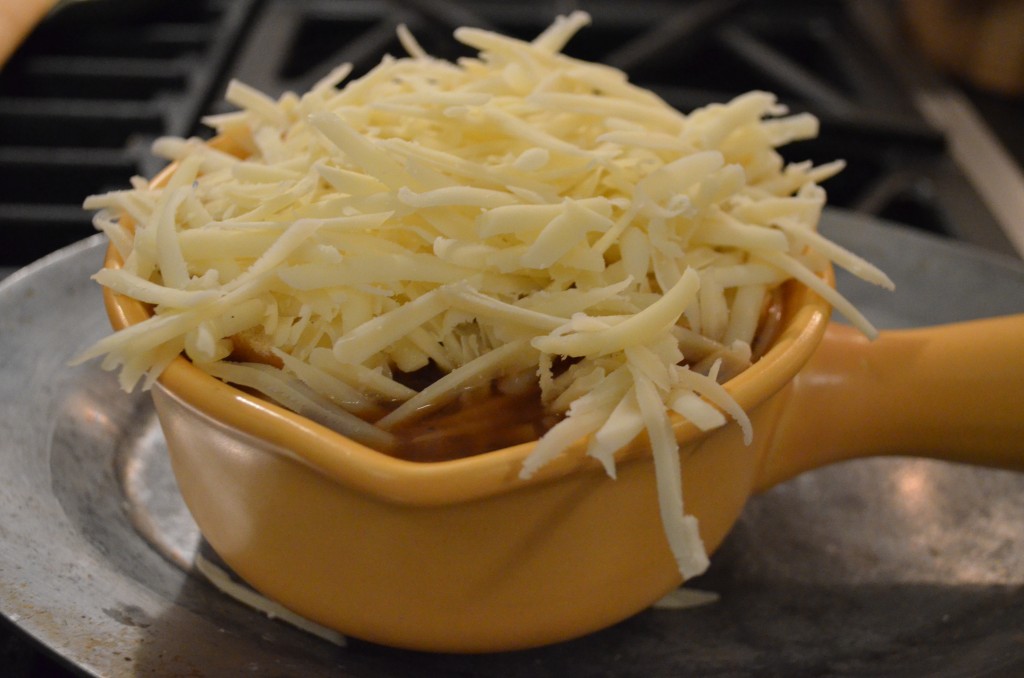
    a yellow soup crock with a lot of grated cheese on top
  7. Using a cookie sheet or jelly roll pan, transfer all the soup crocks to the broiler and broil until the cheese has melted and is starting to brown. Remove from the oven and serve.
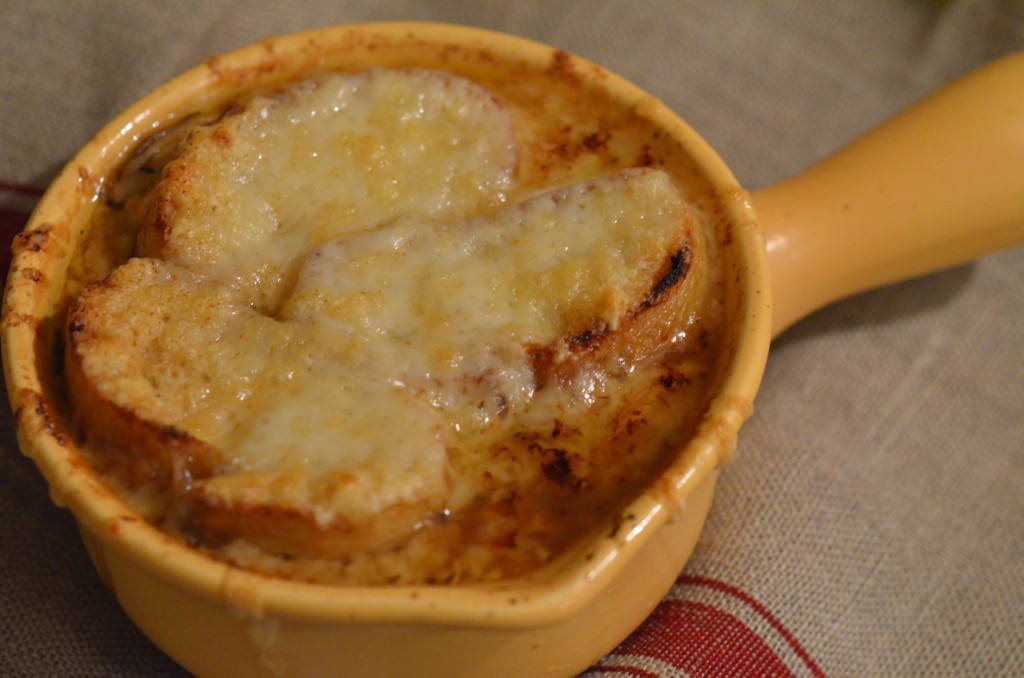
  8. Take your time. Enjoy dinner.finished French Onion Soup in a yellow crock


Jan 072012


butternut squash soup in a blue crock with sour cream and parsley. Yellow crock and tea towel in background.

It’s that time of year… January. The holiday season is over, and those who over-indulged over the last couple of months are vowing to eat better. It’s getting colder and colder outside, and those pesky cold and flu bugs are happily jumping from one person to the next. It’s that time of the year when we need to pay attention to our health and look after ourselves. We need to set ourselves up for a good new year and prepare for the chilly winter months ahead.

I personally had a vicious cold right before Christmas. It was all I could do to just sit on the couch for a couple of days, while I tried to breath. I managed to recover enough to enjoy Christmas with a little help from some homemade chicken noodle soup (the remains of which are in my freezer just waiting to be needed again). I’ve given much thought to the healing power of chicken noodle soup (read my previous blog on this here). But soup doesn’t have to be only for healing when you’re sick. It can also be a great part of healthy living.

Now, I’m not talking about going to the grocery store and buying any number of pre-made soups. There are tons to choose from - condensed soups, chunky soups, soups ready to re-heat in a microwavable bowl, even ‘college staple ramen noodle’ soups. But really, do you think they can hold a candle to homemade soup? I can’t believe anyone has ever really felt truly nourished or cared for after being served pre-packaged soup in a microwavable bowl. Homemade soup, on the other hand, can be full of nutritious ingredients, low in fat, and oh-so-warming on a cold winter’s day. Best of all… soup is SO easy to make and the aromas that fill the house while you’re making it rank up there with the smells of fresh bread baking (which you could also do in order to have bread with your soup, but that’s a whole other blog!).

In its most simple form, soup can be made by simply boiling vegetables in water or broth and then puréeing them into a smooth creamy soup. From there, you can make it more interesting by adding spices or flavors (I love combining a little fruit with vegetables in a soup - think butternut pear, chicken noodle and lemon, or sweet potato and orange as you’ll see below), or keeping the soup chunky with lots of different ingredients visible. You can also thicken soups with ingredients like beans, bread, lentils, potatoes, or rice. There’s really no limit to what you can do with a soup.

As the year begins, I thought I’d share with you a couple of my favorite soup recipes from my cookbook (Blue Jean Chef: Comfortable in the Kitchen). But first, a few tips on soup-making:

  • When using a broth, make sure it is a good-quality, flavorful broth. Buy the best you can, make your own, or ask your butcher if he or she has any stocks for sale.
  • If you’re making a chunky soup, cut your ingredients into uniform sizes so that they cook in the same amount of time and also look nice in the finished product.
  • If you’re making a smooth puréed soup, who cares how you cut the ingredients!? Just chop ’em up and cook ’em!
  • For puréed soups, use only as much water or broth as it takes to cover the ingredients - that makes for fewer batches in the blender when you go to purée it, and you can thin it out later.
  • Always make more than you need. Soup freezes very well, and it’s so nice to have soup on hand in your freezer.

Basic Chicken Noodle Soup

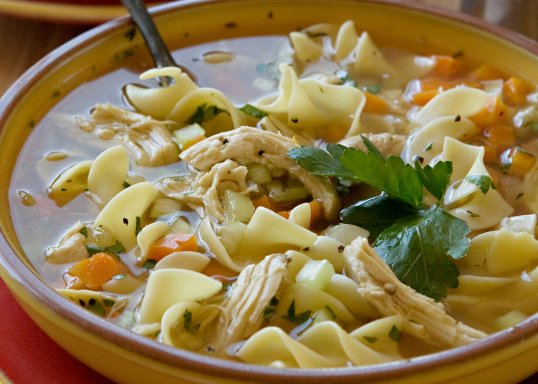
close up on chicken noodle soup with egg noodles and parsley

photography by Jessica Walker

Serves 8 to 10

Ingredients:

  • 1 tablespoon olive oil
  • 1 onion, finely chopped (about 1 cup)
  • 2 carrots, finely chopped (about 1 cup)
  • 2 ribs celery, finely chopped (about 1 cup)
  • 2 cloves garlic, finely chopped
  • ½ teaspoon dried thyme
  • 1 bay leaf
  • 2 quarts good quality or homemade chicken or vegetable stock
  • 3 cups shredded cooked chicken
  • 1½ cups wide egg noodles
  • salt, to taste
  • freshly ground black pepper
  • ¼ cup chopped fresh parsley

Directions:

  1. Heat a stockpot or Dutch oven over medium heat. Add the olive oil and lightly sauté the onion, carrot and celery until tender – about 6 to 8 minutes. Add the garlic, thyme and bay leaf and cook for another minute. Add the chicken stock, and bring to a simmer. Simmer for 20 minutes.
  2. Add the cooked chicken and noodles to the pot and cook until noodles are al dente – about 6 to 8 minutes. Remove the bay leaf from the soup, season with salt and pepper, add parsley and serve immediately.


Curried Sweet Potato Soup

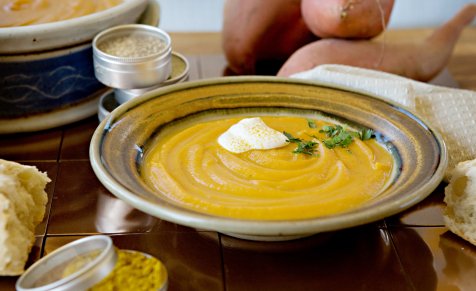
brown pottery bowl with soup, garnished with sour cream and parsley, potatoes in background

photography by Jessica Walker

Serves 6 to 8

Ingredients:

  • 2 tablespoons butter
  • 1 tablespoon olive oil
  • ½ onion, chopped (about ½ cup)
  • 5 to 6 sweet potatoes, peeled and diced (about 6 cups)
  • 1 tablespoon curry powder
  • 4 cups chicken stock, vegetable stock or water
  • ¾ cup orange juice
  • ½ teaspoon salt, or more to taste
  • freshly ground black pepper
  • ½ cup sour cream (optional)
  • 3 tablespoons chopped fresh parsley

Directions:

  1. Melt the butter along with the olive oil in a stockpot or Dutch oven over medium heat. Add the onion and cook for 5 to 7 minutes, just until the onion is translucent, not brown.
  2. Add the sweet potatoes and curry powder, and continue to cook for another 6 to 8 minutes. Add the chicken stock, vegetable stock or water and continue to simmer for another 20 minutes. Stir in the orange juice.
  3. Using a blender, food processor, food mill or immersion blender, purée the soup until no lumps remain and the soup is smooth. Return the soup to the stovetop and thin the soup with water until you’ve reached the desired consistency. Add salt and freshly ground black pepper. Serve with a dollop of sour cream and chopped parsley to garnish.