
Oct 302011
 

It’s that time of year. The time of year when I start planning my Thanksgiving meal (my second Thanksgiving meal that is, since Canada’s Thanksgiving was almost a month ago and I get to enjoy both!). Yes, I’ll probably have turkey and yes, I’ll probably brine it. That’s a given. To me, the most interesting and exciting parts of Thanksgiving are the side dishes that go along with the turkey. So, at this time of year, I start experimenting with different Thanksgiving-appropriate vegetables. This week, I think I’ve not only hit on a winner for my Thanksgiving meal, but I’ve decided this is my new favorite winter squash - delicata squash.

Now, for those of you who don’t know me well, that is quite a statement for me to make. My mother probably just fell over! I have never been a lover of squash. In fact, pumpkin can send me into hiding for weeks. However, I’ve grown up and forced myself to embrace squash (I still haven’t quite conquered pumpkin, but I haven’t given up).
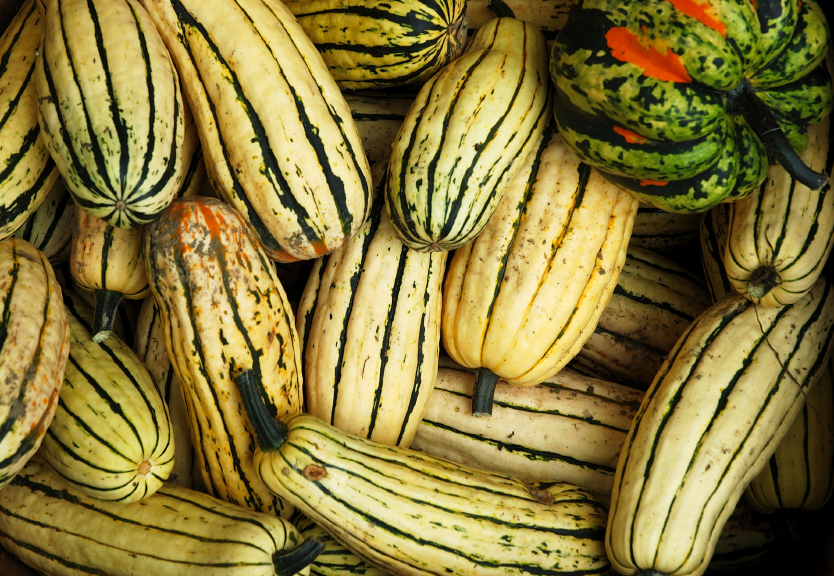
a display of delicata squash as a farmers' market

Delicata squash is a lovely pale yellow or cream colored oblong squash with dark green vertical stripes. It ranges from about 5 to 9 inches in length and is usually about 3 inches in diameter. One squash will feed two people easily. Winter squash and summer squash are both available year round. They differ in that winter squash are harvested and eaten when the squash has reached the fully mature fruit stage - the seeds have fully matured and the skin has hardened - while summer squash are harvested when still immature with softer skins and seeds. Winter squash became known as “winter squash” because they can be stored longer than summer squash. They are better “keepers” and can be stored into the winter months.

Now, delicata squash does not keep quite as long as most winter squashes, but how many of us are storing vegetables for months? What I really like about delicata squash is the fact that you don’t have to peel it. The skin is edible and really quite enjoyable. Butternut squash has been popular over the years, but peeling and chopping butternut squash makes it more work in the prep stage and deters many cooks. With delicata squash, you simply cut it into rings or wedges, removing the seeds one way or another and then roast, sauté, steam, or even microwave it.

Here are a couple of recipes to get you started with this fabulous and easy-to-prepare squash. The first is very simple and shows off the flavor of the delicata squash. The second is a little sweeter, but oh so tasty! Whether you’re a fan of the savory or the sweet, one of these recipes is sure to become a favorite of yours!
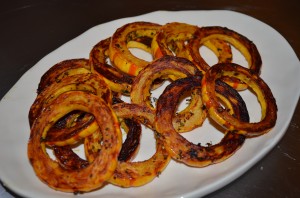
rings of roasted delicate squash on a white oval plateSimply Roasted Delicata Squash

Serves 4

Ingredients:

2 delicata squash

1 tablespoon olive oil

1 teaspoon chopped fresh thyme

1/4 teaspoon salt

freshly ground black pepper

Directions:

  1. Pre-heat the oven to 400º F.
  2. Starting at the more rounded end of the squash, cut the squash into horizontal slices, about 3/4-inch thick. When you can see the seeds inside, scrape out the seeds with a teaspoon. Then, continue to slice the squash into rings.
  3. Toss the rings of squash with olive oil, thyme, salt and pepper and spread out onto a baking sheet in one layer.
  4. Roast at 400º F for 20 – 25 minutes, or until tender, turning the rings once during cooking.
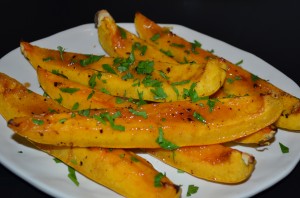
 

Wedges of roasted delicate squash with parsleyMaple Roasted Delicata Squash

Serves 4

Ingredients:

2 delicata squash

2 tablespoons butter

2 tablespoons maple syrup

1/8 teaspoon ground cinnamon

1/4 teaspoon salt

freshly ground black pepper

2 tablespoons chopped fresh parsley

Directions:

  1. Pre-heat the oven to 400º F.
  2. Cut the squash in half lengthwise and remove the seeds with a teaspoon. Then, cut each half into about 2 or 3 wedges.
  3. Melt the butter in a small saucepan and mix with the maple syrup and cinnamon.
  4. Spread the squash out on a baking sheet in one layer and brush each wedge with the butter and maple syrup mix. Season with the salt and freshly ground black pepper.
  5. Roast at 400º F for 25 minutes, or until tender. Remove from the oven and sprinkle with parsley.


Oct 162011
 

I’ve been cooking for years now, both professionally and for personal enjoyment. What never ceases to amaze me, and one of the things I love most about cooking, is that I am constantly learning new things and changing the way I cook. I eat out at restaurants a lot and learn about new ingredient combinations. I read a lot of food magazines and books and learn about new cooking techniques and new foods on the market. I play with ethnic dishes when I cook and learn about entirely different cuisines. Finally, I just cook a lot and I learn through experience about what works and what enhances a meal. This past year, the one lesson that has affected me the most involves my use of fresh herbs.

Using fresh herbs is not new to me. I’ve always preferred to cook with fresh herbs over dried herbs for the most part. I like the fresh, bright and pure flavor that fresh herbs provide. This year, however, I’ve started adding way more than I’ve used before. Part of the reason for that is my herb garden. Any gardener knows that pruning and pinching herbs is good for the plant and generally helps it grow. So, this past summer, every time I went into my garden to cut herbs for a meal, I cut more than I needed. Then, I started using more than I felt I needed, and the flavors really started to shine and complement the dishes I was making. They became a critical ingredient and flavor of their own accord, rather than a supplementary flavor or just color garnish for the dish. This is not rocket science or any new revolutionary culinary technique. It’s just my own personal observation, and frankly it’s probably a little late for me to be making this realization, but better late than never. Sometimes we get a little set in our cooking ways, and a small change can make a big difference.

Many of you have asked me about using fresh herbs in meals and how using fresh herbs differs from using dried herbs, so I thought I’d take a little time to talk about herbs. There are two main rules to using herbs in your cooking.

Rule #1: dried herbs should be added to foods at the beginning of cooking so there is time for the flavor to be released, while fresh herbs should be added at the end so that their flavor remains bright and doesn’t disappear.

Dried herbs are dried (obviously!) and need some time to re-hydrate and release that flavor. Consequently, you should use dried herbs when your cooking technique takes some time and involves some liquid. Chilis, stews, braises, soups - these are all dishes that could use dried herbs, added at the beginning of the cooking process. Fresh herbs tend to have a cleaner, more pure and brighter flavor, but this flavor is delicate and can be completely cooked away if the herbs are added at the beginning of cooking. For instance, I love cilantro added to chili, but only at the very end, right before serving.

Rule #2: when converting from dried to fresh herbs in a recipe, you should use four times as much fresh herb as dried (AND you should add it at the end of cooking, rather than at the beginning).

Just like dried fruit, dried herbs have a very concentrated flavor, so you can use a lot less. At the same time, their flavor can become stale. We all keep our herbs and spices way too long. Often, we even relocate our home and pack our dried herbs and spices to take with us! Generally, dried herbs and spices will last for six months before they lose their impact. I’m not saying you should throw all your dried herbs out (although, you really should throw all your dried herbs out), but I am suggesting that you purchase herbs in smaller quantities and replace them more frequently.

Aside from the two main rules, you still might be wondering about what herbs to put with what foods. I generally think about the ethnicity of a dish and add herbs that are common to that cuisine. For example, Italian cuisine uses a lot of oregano, parsley, basil, rosemary, and sage. Greek food includes a lot of dill, oregano, rosemary, and mint. French cuisine incorporates a lot of parsley, basil, rosemary, thyme, tarragon, lavender, and sage. Asian herbs include cilantro, lemongrass, and Thai basil. If you know the type of cuisine you’re cooking, which herbs to use comes pretty naturally and you really can’t go wrong.

Of course, there are some classic food-herb combinations. Here is a little list of suggested herb-food pairings. It certainly is not exhaustive, but it might give you a little idea of how to use different herbs.

Parlsey: almost anything that you want to give a fresh grassy note to; soups, butters, pastas, eggs/omelets, lentils, beans… really anything

Sage: squashes (like butternut, pumpkin), poultry, beans (white beans), lamb, stuffing, apples, goat cheese

Chives: potatoes, eggs, goat cheese, anywhere you want a mild onion flavor

Rosemary: potatoes, lamb, chicken

Thyme: chicken, fish, vegetables

Basil: tomatoes, pesto

Tarragon: salads, fish, potatoes, chicken, anywhere you want a slight licorice/anise flavor

Dill: potatoes, goat cheese, fish, shrimp

Oregano: chicken, pizza

Cilantro: curries, salsas, chilis

Mint: lamb, potatoes, tea

Really, the best way to learn about herbs, where to use them, and how much to use is to do exactly what I did - use them! The beautiful thing is you can learn something new every day!

Oct 112011
 

It’s been years …many years since I’ve read a children’s book, but that’s just what I did the other day. Why would I read a novel written for young people? Well, because it wasn’t just any novel. Stir it Up! is the story of a young girl of Trinidadian heritage, living in Queens New York who aspires to be a Food Network star. Thirteen-year-old Anjali loves working in her father’s roti shop, takes cooking classes and cooks with her grandmother all the time, so when the chance comes around for her to enter the Food Network’s Super Chef Kids competition, she jumps at it. The only trouble is that the competition conflicts with her parents’ hopes and dreams for Anjali and she has to make the tough decision about following her parents’ orders or pursuing her dream. The story is sweet (no pun intended), but what I really liked most were the Trinidadian recipes sprinkled throughout the book.

Trinidad is a small place with a big personality. But even with that personality and zest for life which you feel is loud enough for the whole world to hear, it’s not every day that you come across the mention of Trinidad in a novel or find a cookbook from Trinidad. (I did encounter a crossword puzzle clue the other day where “Trinidad” was the answer, but that’s just as uncommon!) So, when I first saw Stir it Up!, I felt it was worth a read, even if I am thirty or so years over the recommended reader age!

Stir it Up! is written by Ramin Ganeshram, which is another reason why I wanted to read it. Ganeshram also wrote Sweet Hands: Island Cooking from Trinidad and Tobago, one of my favorite West Indian cookbooks, so I looked forward to seeing what recipes she had included in this story about and for young people - Coconut Dark Chocolate Chip Cookies, Deema’s Easy Curry Chicken, Shrimp Burger Pitas, Trini-Style Salmon Sushi Rolls, Creole Rice, Coconut Rice Pudding, Ginger Beer to name a few. The recipes are easy to follow, approachable, and would be enjoyed by both young and old. If you haven’t tried any Trinidadian food, this would be an easy way to start exploring.

As for me, I’ll certainly be making some of the recipes, perhaps the Ginger Beer first, before all the mint in my backyard dies away for the winter. Then, I’m going to pass this book on to my niece, so that she too can feel a connection with part of her Trinidadian roots. Maybe she’ll make me a Coconut Dark Chocolate Chip Cookie some day.

Oct 022011
 

We move quickly in this day and age. We’re working, rushing from place to place, busy going from one thing to the next. Stopping or slowing down just enough to make dinner sometimes seems like a hurdle too high. In fact, I heard recently that the average working mom is willing to spend 12 minutes making dinner. 12 minutes?! That’s just not right. I take time to cook meals because I enjoy it, but I rarely slow down enough to really do something that isn’t on my to-do list. The other day, however, I did just that and it felt really… really good. So good, in fact, that I plan to do it again soon. It only took me an hour and at the end I felt like I’d learned something, experienced something new and got to eat the end result. I made fresh mozzarella cheese.

It may sound impressive, but it really couldn’t have been easier, especially since everything I needed was in this cool mozzarella cheese-making kit from Roaring Brook Dairy - a thermometer, a pair of latex gloves, cheese salt, citric acid and a tablet of rennet (enzymes that help coagulate the milk, separating the curds and whey). The only ingredients I had to supply were a gallon of milk and a bottle of water.

The instructions included in the kit were great - accurate and easy to follow, but here’s how to make mozzarella in a nutshell. The first step in the process was to dissolve the rennet and citric acid in two separate containers of bottled water. Easy enough. Then slowly heat a gallon of pasteurized (but not ultra-pasteurized) milk to a temperature of 85 degrees F.

Gently stir in the citric acid. Continue to heat the milk until it reaches 100 degrees F and add the dissolved rennet. Stir gently in an up-and-down motion for 30 seconds (bringing your slotted spoon out of the milk and putting it back in - stirring vertically, if you will). Continue to heat the milk until it reaches 105 degrees F and then let it sit, covered for 10 minutes. At this point, the curds will have separated from the whey. You can check the readiness of the curds by pressing a teaspoon into the curds - it should leave a dent.

Press the back of a teaspoon into the curds...

...it should leave a dent if the curds are ready to strain.

Remove the curds from the pot with a slotted spoon (I used a tool called a spider which was perfect) and place them in a colander, straining as much of the whey out as possible and even pressing on the curds to release more of the watery whey.

The Prepology silicone colander makes squeezing the curds easy.

Once you’ve separated as much of the whey as possible, microwave the curds for a minute. Then, using gloves to protect your hands from the heat, fold the curds over on themselves to distribute the heat and squeeze out more of the whey. Heat the curds again for 30 seconds or until the curds are about 135 degrees F. Fold the curds over on themselves again, kneading the cheese until it becomes shiny and stretchy.


Then, add the cheese salt, sprinkling it over the curds as evenly as possible and stretch the dough, pulling it apart and then folding it together again.


A gallon of milk will make two large mozzarella balls, so divide the curds into two pieces (or more if you want to make smaller mozzarella balls). Shape the balls by stretching the cheese over itself, pinching it into a knot at the bottom. Once formed, pop the mozzarella balls into ice water for few minutes and then wrap in plastic wrap. Done.

It was easy. It was relaxing. It involved a lot of waiting for the right temperature or letting the curds sit and coagulate. Believe it or not, it was really peaceful. Even the dogs lay down in the kitchen and slept. At the end, I was able to make a beautiful Caprese salad with tomatoes and fresh basil, balsamic vinegar and extra virgin olive oil, and fresh…really fresh… mozzarella cheese. And the little knot of cheese that was left after pinching the curds into a ball… well, that went to a relaxed, peaceful and yet attentive kitchen helper.

You can learn more about Roaring Brook Dairy here. Their cheese-making kit would make a great gift for a food-lover and would be a really good project for young adults. Check them out.