
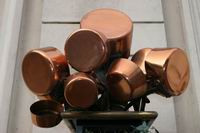
 I love copper. I always have. Perhaps I’m just like a magpie, attracted to shiny things. But no, because I’m not really enthralled with diamonds (thank goodness!), and I don’t find copper beautiful only when polished and shiny. I’m actually quite fond of its tarnished look as well. I like to see copper when it’s a dull, dark orange, perhaps with a touch of that blue-ish green … what is that? Rust? Corrosion? You find copper like this in antique stores, and what draws you to them is the beauty that lies within, or beneath. What I really like about its ‘you’ve-let-yourself-go’ appearance is that copper can change from its dull look to the opposite extreme - a brilliant beauty that’s hard to resist (at least in my case). I once read in a magazine that in order to look consistently great, you shoudn’t try to look your best every day. If you are always trying to look your best, then on your lazy days everyone will notice the lapse in your appearance. It is better for them to notice the really good days instead. Copper is like that to me. I think I appreciate its newly polished beauty so much because I also see it on its relaxed everydays.
Copper is more than just a pretty face, however. It’s also incredibly functional, especially in cookware. It’s quite widely known that copper is one of the best metals from which to make pots and pans because it is an excellent conductor of heat. That means that it gets hot fast, and cools down quickly. Why is that important? Because it gives you more control. You’re better able to control the temperature of your food and therefore control how it is cooking. That’s why copper is often used in candy making, where the temperature of the sugar needs to be closely monitored. It is a pleasure to cook anything with a copper pan, however. I think that perhaps it is hard to really grasp how effective copper is as a cooking metal until you actually try it and see for yourself.
The first experience that I had with copper cookware was when I was working in a Michelin rated restaurant in France. At L’Ousteau de Beaumanière, the kitchen was designed in the traditional French manner. That means that instead of a “line”, where different stations were defined by the equipment they used (oven station, versus grill station, versus saute station) and were positioned in a line next to one another, they worked on a “piano”. The “piano” was a square cooking unit, with burners and a large griddle surface, and the cooking stations, defined by the food they were cooking, were across from one another. So, the fish station would be facing the meat station. At L’Ousteau, the meat station used stainless steel pans and the fish station used nothing but copper. These pans were washed by the dishwasher (a person, not a machine) and then polished by the pot polisher, another person whose job it was to solely polish each pot twice daily. When the kitchen closed for the afternoon or for the night, all the pots were left on the “piano” and looked beautiful. I still have photos of all those impressive copper pots in the squeeky clean kitchen waiting to be used for the next service period.
Copper is special and conjures up special memories for me. I still have the 4 quart copper saucepan with beautiful lid, made in France, that was a going away gift from my Chef when I left a restaurant in Berkelely, California to move to Vermont. Everyone oohed and aahhed when I opened the gift. Clearly, if the chef was giving me copper, it was a gift from her heart.
I also remember polishing my mother’s copper and brass with her years ago. It was a nice thing to do - sit with my Mum in front of the fire and chat while we each picked a piece to polish next.
I love letting copper tarnish and lose its brilliance just so that I can polish it up again and see the fruits of my labour. It’s immensely satisfying to me, and I think this is where I differ from other lovers of all things copper. (Indeed, I’ve been told that perhaps I should see someone about this problem!) I’ve heard people complain, saying that they would get copper cookware for its superior cooking qualities, but they don’t want to have to clean it. I don’t understand this. Don’t get me wrong - I wouldn’t want to be the pot polisher at L’Ousteau de Baumanière, but I love cleaning copper. It is not hard to do. Simply take half a lemon and a little salt, sprinkle the salt on the lemon half and rub it on the copper. It’s as easy as that. I don’t know many things that take so little effort and give such great and immediate results. It’s something to do when you’re feeling unsuccessful or lacking in achievement. Nothing could boost your morale faster. Give it a try!
Still, I realize that time is a valued commodity in everyone’s life, and not everyone wants to clean copper. I also realize that I don’t have time to clean everyone’s copper for them. THAT’S why I’m so excited about tonight. Tonight we’re broadcasting our first full hour show of Technique cookware AND we’re launching a brand new line of cookware. I’m excited because it’s beautiful, brilliant, an excellent performer in the kitchen, and yes, it has a copper base. This is a pan that will make everyone happy, however, even those non-cleaning copper types. Why, you ask? Well, because we’ve put a new material on the very bottom of the pan that keeps it light weight, is durable, AND does not require cleaning. What could it be? What will they think of next? Kryptonite? No, wrong superhero. Think Wonder Woman.