
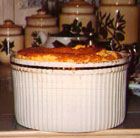
My father emailed me one day and asked me for advice (any) on making soufflés. He had decided that part of his weekend would consist of conquering this culinary quest that drives panic into the hearts of so many cooks. My father doesn’t cook very often, but when he does … I feel for my mother. It’s not that Dad’s a bad cook. On the contrary, he’s quite a good cook when he wants to be. In fact, he’s good at most of the things he wants to do (except mowing a lawn, but that’s another story.. and he’s promised never to mow another lawn - ever!). The challenge with my father cooking is that he’s the kind of cook that needs a sous chef, and since he and my mother are the only ones at home these days, she’s the only one who can fill those shoes. On receiving my father’s email, I decided that the only fair thing to do, in order for my father to be as successful as he would want to be, and for my mother to have an enjoyable weekend, was to provide Dad with as much information on soufflé-making as I could muster up from my soufflé knowledge base.
I like making soufflés. Actually, what I really like is teaching others to make soufflés. I think it has something to do with the fact that the making of this dish is grounded in science, but there is always a point where the cook must relinquish control and just watch and see what happens.
Here’s the science of it…
Soufflés are made up of three components: a flavorful base, whipped egg whites, and air. The egg whites are the important component, for they hold the air which gives soufflés their famous rise. You see, egg whites are made up of proteins called conalbumin. These proteins look like crooked, bent strands, so to speak, but when you start to whip them with a whisk, the proteins “denature”. That means they lose their crooked natures and straighten out. (Whoa! That sounds a little too much like demented delusional child rearing!) Once straight, they tend to stick together, forming a sheet of protein. We see this as the egg whites losing their translucent appearance and becoming white and foamy. As you continue to whip the egg whites, air gets worked in and is trapped in the sheets of protein. When the whites have enough body that a little hershey’s kiss is formed by the whites when you hold your whisk in the air, and yet the entire mass can still slide around in the bowl slightly, you have reached “soft peak stage”. That’s when you want to stop. If you whip the whites too much, you’ll get to “stiff peak stage”, you’ll be able to turn the bowl upside down with the egg whites inside, and it will be hard to move on to the next step.
Once you’ve got the air and egg whites under control, you simply have to introduce the flavorful base. This just takes some care. Don’t stir the whites and base together; you’ll stir away all the air you just worked so hard to incorporate into the whites. Instead you need to “fold” the two together. Add the egg whites to the base in three batches, and, using a spatula, try to gently cover the egg whites with the base, rather than stir. Keep on covering the whites up, until you have gently but completely combined the two. Now you have a raw soufflé. When this goes into the oven, the air that is trapped inside gets hot and, as gasses do, expands. As the air expands, it causes your soufflé to rise. At the same time, however, the oven is hot and is cooking the proteins in the egg whites which start to set up and become firm. It’s a race against time. How far can your soufflé rise before the egg white proteins set up?
That’s all there is to it. It’s not difficult, but the following tips will help you along the way.
Egg Whites
It is critical that you separate your egg whites from the egg yolks completely. If there is any egg yolk, or any fat at all for that matter, in the egg white, you’ll be whipping the whites until the cows come home with no success what-so-ever.
Egg whites separate more easily when they are room temperature, but the egg yolks are also more likely to break and contaminate your whites at that temperature. So, you decide: if you’re a careful cook, separate the eggs at room temperature; if you’re a clutz, separate them straight out of the fridge.
Separate your eggs using an egg separator (silly little plastic contraption that you can find at any kitchen store), or using your clean hands (remember, any fat in the whites at all will prevent them from whipping up). Just crack the egg into your hand and let the whites slip through your fingers while the yolk stays in your hand. I once had a student who said that was “the grossest thing” she’d ever done. Wow. Wait until we get to cleaning out a chicken!
Egg whites are easier to whip up at room temperature, so let your separated eggs sit out while you prepare the rest of your ingredients.
Old egg whites whip up more easily than fresh eggs, but that’s still no reason to use old eggs!
Egg whites do not stand up well to hot ingredients. So, after you’ve made your flavorful base, let it cool to at least room temperature before you try to fold the egg whites in.
Equipment
Use a balloon whisk to whip your egg whites. This is a whisk with a very bulbous wire base, that incorporates air much faster and more easily than say, a sauce whisk, which is skinny.
Using a copper bowl to whip your egg whites will give you a higher soufflé. Why? Well, remember conalbumin? When you denature/whisk conalbumin in a copper bowl, it turns into copper-conalbumin, and copper-conalbumin has different properties that lend themselves well to soufflé-making. Most importantly, (and I love this next sentence) copper-conalbumin has a higher coagulation temperature than conalbumin. What!? In layman’s terms, that means that you have to get your soufflé to a higher temperature in the oven in order to get the egg whites (whipped in a copper bowl) to set up. So, in that race against time, where we’re trying to see how high our soufflé can rise before it sets, soufflés that have been made in a copper bowl will rise higher. (I told you soufflés were grounded in science.)
You will need a soufflé mold, of course. The most important aspect of such a mold is that it has straight sides. The soufflé needs straight sides to rise. The dish can be made of metal or it may be ceramic, but it must have straight sides. You must also grease the sides and bottom of the dish, so that your soufflé doesn’t stick to it. For a chewy crust, you can dust the inside of the dish with fine breadcrumbs or parmesan cheese for a savory soufflé, or with sugar or finely ground cookie crumbs for a sweet soufflé.
You may need a collar on your soufflé dish. A collar is simply a piece of parchment paper that you tie around the dish, and which extends above the top of the dish. You really only need this for high-rising soufflés (some rise higher than others based on the weight of the base and the number of egg whites you use), but it is better to be safe than sorry, so use a collar. Don’t forget to grease the collar as well as the dish, or you’ll be sad because you will have put all this hard work into your meal and the presentation will be lost. Tie the greased collar around the soufflé mold with kitchen twine, and do so before you add the soufflé batter. You want the soufflé batter to come within half an inch of the top of the mold, and it is a pain in the neck to try to tie a collar on after the mold is full.
Myths
If you make a lot of noise while making a soufflé, it will fall.
Not true. Make as much noise as you like. Soufflés don’t have ears. I think a mother must have made up this one, and I’ll leave it to your discretion as to whether you’d like to continue that myth in your household in order to enjoy some peace and quiet. Who knows? Maybe that alone would be a reason to make a soufflé?
If you slam a door, the soufflé will fall.
That depends on what door you’re talking about. If you slam the kitchen door, the soufflé couldn’t care less. If you slam the oven door, however, the soufflé might have a bone to pick with you, due to the draft and change in air pressure. Besides, it is not good for your oven to slam the door. Go slam some other door!
Soufflés can’t be made ahead.
Wrong. You can actually make the soufflé up to the point of baking it and then stick it in your refrigerator for a few hours (not more than four, ideally). When you are half an hour or so away from eating, pop it into the oven and relax. This is an excellent way to surprise and impress guests - they’ll wonder how you pulled the meal off without any last minute stress in the kitchen. It works especially well for desserts - pop it into the oven as you sit down for dinner. (I’m slowly but surely elimating all your excuses for not making soufflés!)
Soufflés always fall.
True. Soufflés do always fall, but that’s all part of the excitement. You see, that air that expanded in the oven, causing your soufflé to rise is going to cool down when you take it out of the oven. When it cools, it will contract and your soufflé will slowly sink. This usually happens within five minutes of taking it out of the oven, so make sure your guests are seated and ready when you are, for the soufflé will wait for no-one.
Now you have all the information, I suppose you need some recipes. Well, you can find a million recipes for soufflés on the Internet, and now you know the reasons behind the instructions and all the tips and trick in between, which will help you be successful.
Dad made a Grand Marnier soufflé that weekend. He is a very good student. He bought a copper bowl (which he threatens to use as a bicycle crash helmet when not making soufflés). He used a balloon whisk. He whisked his egg whites by hand, although the sous chef had to help him out in the end. He put a collar on his soufflé dish. He baked it until it was still a little runny in the center - very French! He and Mum ate the whole thing for dinner - nothing else!
Mission accomplished.
Now you know the science of it, make your own soufflé. Check out the recipes on the site, including:
Great blog! I cannot remember too clearly but I think I found your blog through a link someone shared on Twitter. . I truly love the stuff I have read on your website and plan to keep reading when I get more time. Do you have a Twitter profile?
I made the raspberry soufles. Each had it’s owm little pan, We thought they tasted better the second day. We kept them in the fridge.