
Sep 252011
 

Whenever it rains, I think about all the places that I’ve lived before my current home. It seems all the apartments that I’ve rented over the years had one thing in common - every time the skies opened up and poured rain, my ceilings would start to weep (sometimes sob!) and I’d run around trying to catch those teardrops in buckets everywhere. These days when it rains, I do still glance up cautiously at my ceiling, but instead of panicking and worrying about damage, I feel grateful that my roof doesn’t leak and I’m safe and sound and dry inside.

It’s been raining a lot these past few weeks. Indeed, Hurricane Irene made it rain harder than I’ve ever seen it rain before in my lifetime. Hurricane Irene is behind us now, but she left paths of destruction in her wake, and one of those paths really battered the tomato crop in the Northeast. Fortunately for most of us, California and Florida are the nation’s biggest producers of tomatoes, but growers in Virginia, North Carolina, New Jersey, and New York all suffered damage to their heirloom tomatoes and many crops were lost. Consequently, in my part of the country, farmers’ markets are not filled with tomatoes as plentifully as they normally would be at this time of the year. The local tomatoes are scarce.

And so… as the tomato season comes to a close in this rainy September, I’m also grateful for the heirloom tomatoes that I can enjoy. Here’s a simple and quick way to really enjoy the end of the tomato season:

Easy Tomato Bruschetta
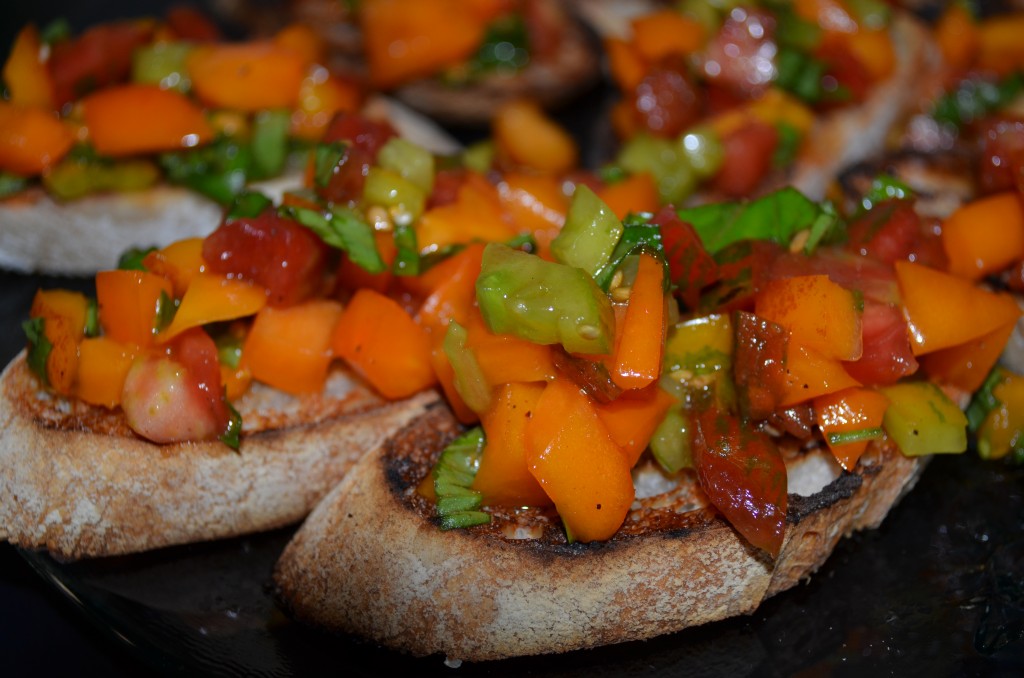
Colorful red, yellow and green tomatoes on toasted baguette

Ingredients:
1 baguette
olive oil
1 clove garlic, peeled and left whole
4 heirloom tomatoes
1 tablespoon balsamic or red wine vinegar
2 tablespoons extra virgin olive oil
½ teaspoon salt
freshly ground black pepper
20 leaves fresh basil, thinly sliced

Directions:
1. Pre-heat the oven to 350º F.
2. Slice the baguette into ½-inch slices on the bias, and place on a cookie sheet. Brush the bread slices with the olive oil and toast in the oven until lightly browned – about 20 minutes. Alternately, grill the slices of baguette on your outdoor grill.
3. While the bread is toasting, prepare the tomato mixture. Chop the tomatoes and place in a bowl. Add the vinegar, olive oil, salt and pepper.
4. Once out of the oven and as soon as you can handle the crostini, rub the garlic clove very lightly on each one.
5. Top each crostini with some of the tomato mixture. Place on a platter, and sprinkle the shredded fresh basil over the top.
Sep 192011
 

Everyone has a favorite grain, don’t they? Well, perhaps not, but I always have favorite foods that I can’t get enough of… until I move on to something else. Lately I’ve been feeling a little fickle with my grains. Rice has tried to stay on the top of my list, luring me with the wonderful smell of a freshly made pot of Basmati. My morning steel cut oats are still making a run for the lead position in my heart, and even quinoa tried to get in the mix. Still, I have chosen a new “best grain” and it’s neither rice, nor oats, nor quinoa. It’s farro.

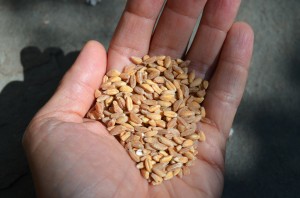
Farro held in the palm of someone's left hand.

Farro - the most ancient grain.

I remember when I first tasted farro, years ago as a cook at Zuni Café in San Francisco. Since then, however, farro and I have not crossed paths too often. This summer we were reunited and I think this time the relationship is going to last. First things first - what is farro?

Believe it or not, there’s quite a debate about what farro actually is (emmer, einkorn, spelt), but it is generally accepted that farro is the world’s most ancient grain - the grain from which all other grains are derived. That’s sort of cool in and of itself, but there’s so much more about farro to like. It’s a whole grain, with the bran intact and consequently has a lovely nutty flavor. It is also a very nutritious grain. Farro is a great source of complex carbohydrates and while it is an ancient form of wheat, it has more than twice the fiber and protein of modern wheat. So why have we not seen farro hanging out in our supermarkets? Well, farro is not a high-yielding crop. In fact, a field of farro only yields about a sixth of what a similar field of wheat will yield. It was a staple ration of the Roman legions, but after the fall of the Roman empire, other higher-yielding grains were developed and took over. Farro fell by the wayside. But, farro didn’t disappear completely and has been popular in Italy and France for quite some time. Though it’s not a standard grocery store item in the USA yet, you can find farro at high-end groceries, specialty stores or even online (amazon.com).

When it comes right down to it, farro is a grain with a fancy reputation, but is cooked just like any other grain - it is boiled in water (or other liquid) until soft(er). Simple. Easy. And delicious. Farro works well in soups, stews, as a cold salad, but my favorite preparation of farro is in a farrotto - just like a risotto, but made with farro instead of rice. When I compare a farotto to a risotto, farro emerges as the winner for a couple of reasons. A farrotto is easier to cook than risotto - just boil it in the liquid until done to your liking and then stir in other cooked vegetables or ingredients. Risotto, on the other hand, requires a gradual adding of liquid and diligent attention, stirring regularly. Farro is practically impossible to overcook, whereas you can easily overcook risotto resulting in a gloppy mess. Farro feels healthier and less rich than risotto. I expect this is mostly because I omit the cheese at the end of cooking a farrotto that I always add to risotto, but regardless, it’s a healthy grain and you feel healthy when you eat it. Finally, farrottos are a great way for me to incorporate all those summer vegetables that were abundant the last couple of months. It was the base for many lovely delicious vegetarian summer meals.

You may not have a favorite grain, but here’s the good news… I’m willing to share! Give farro a chance!

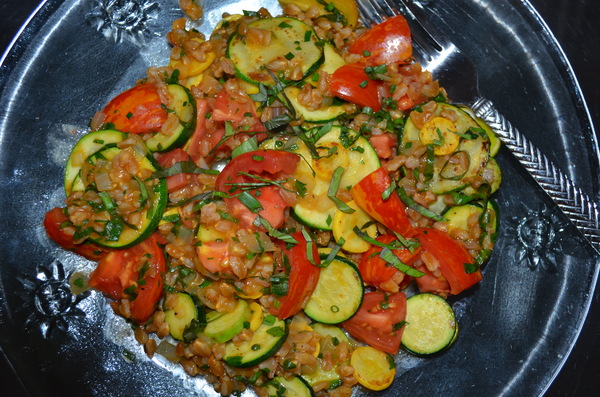
farrotto on a glass plate with zucchini and tomatoes

Farrotto with zucchini, tomatoes and basil.

Basic Farrotto
Ingredients:
2 tablespoons olive oil
1/2 onion, chopped
1 cup farro
4 cups vegetable stock
salt and freshly ground black pepper

Directions:
1. Heat a large sauté pan or Dutch oven on medium to medium-high heat. Add the olive oil and cook the onion until translucent and tender - about 6 to 8 minutes.
2. Add the farro and stir well, cooking for a minute or two. Add the vegetable stock and bring to a simmer. Simmer the farro for 45 minutes, or until tender. (Don’t expect the farro to become really soft - farro should always have some bite and chewiness to it.) If the liquid reduces and disappears before the farro is tender to your liking, simply add water and continue to cook until it is tender.
3. At this stage, remove the farro from the stovetop and stir in cooked vegetables and fresh herbs (see suggestions below) to finish the farrotto, or store the farrotto base in containers in the fridge or freezer until you’re ready to use it.

Farrotto Suggestions:
- Zucchini, tomatoes, parsley, chives and basil
- Mushrooms, peas and mint
- Butternut squash, apple and sage

Sep 132011
 

When I was a university student, I worked part time in the university pub. No, I wasn’t a cook, or a waitress or even a bartender. I was security. (…pause for the laughter to subside) Obviously campus security at the pub wasn’t very tight at the time. Anyway, each night when we closed the pub, the staff would gather for a staff drink (or two) and then we would all head to Lino’s - the 24 hour diner - for our usual plate of poutine.

Poutine - A delicious mess!

Ahh, poutine! That Canadian mixture of french fries, Cheddar cheese curds and brown sauce or gravy. It’s quite atrocious in appearance and yet it has survived and become a cornerstone of Canadian food, along with back bacon, Nanaimo bars and butter tarts. One story says that the first chef asked to combine these ingredients on a plate exclaimed “ça va faire une maudite poutine” or “that will make a damn mess”. Oh, but what a delicious mess it is!

Poutine originated in Quebec in the 1950s or 60s and strangely it has been as equally loved as despised by French Canadians. Though eaten by all and (I have to assume) thoroughly enjoyed, it has been a source of embarrassment for many Quebeçois throughout the years, for you see, the French are very proud of their cuisine, and this mess (or poutine) is certainly not haûte cuisine. There are even stories in Canadian politics of Quebeçois politicians refusing to answer the question “do you like poutine?” at press conferences, not wanting to be associated with an image of themselves with gravy covered fingers in front of a plate of melted cheese and potatoes, I suppose.

Since the 1960s, poutine has traveled and is now available all over Canada. There’s even a Poutinerie in Kingston, Ontario, where I spend much of my time (in Kingston… not at the Poutinerie!). Poutine did travel South of the border and “Disco Fries” became popular in New York in the 1970s, but they were made with grated Cheddar cheese and a milk-based gravy, rather than the squeaky cheese curds that can be found in bags at the side of convenience store registers all over Quebec and a stock-based sauce (or velouté). “Disco Fries”, however, seem to have gone the way of Disco itself, and if poutine is to be found at all in the United States, it is usually dressed up by a trendy chef - with foie gras for example.

Casse-Croûte Chez Ginette - a fine Poutine establishment!

So, whenever I head back to Quebec for a visit, I’ll find myself in front of a plate of poutine at some point on my trip. This August when I was in the Charlevoix region, we made a special trip to Casse-Croûte Ginette for a plate of poutine along the St. Lawrence River. Now, even though I’m not twenty anymore, living on poutine and burning off calories by just existing, I thought I could manage une grande poutine by myself. I felt empowered and brave as I stared at the enormous styrofoam container placed in front of me, and dove in with plastic fork in hand. I guess my eyes were bigger than my stomach, however, and I admit that the poutine (or my better judgement) won in the end. I laid my fork down in surrender and walked away. But, I walked away with the tasty memory of a delicious mess. Until next time…

Poutine - 1 Me - 1/2?