
Jan 262006
 

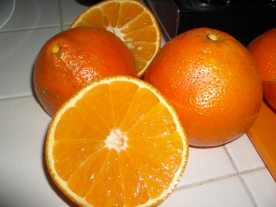
It doesn’t last long, but it’s happening right now! It’s Honeybell season.

As promised, juice dripped down my chin and through my fingers as I enjoyed my first Honeybell last week. It was, indeed, the juiciest “orange” I’ve ever eaten. No wonder the company that was selling my particular case of the fruit included two plastic bibs with the purchase. It did make me wonder, however. Two bibs? Did they expect me to eat twelve Honeybells in one sitting, or was I supposed to wash that thin plastic bib and re-use it? I resorted to eating over the sink.

A Honeybell is not actually an orange, though it looks much like one. It is in fact a hybrid cross between a Duncan Grapefruit and a Dancy Tangerine, which first appeared in Florida in the 1930s. Also known as a Minneola Tangelo, it is deep sunset orange in color, and feels noticeably heavy. That weight comes from all the juice inside, waiting to burst forth and turn you into a sticky mess. It is almost startling how much sweet and slightly tart juice can be squeezed out of one single Honeybell (about 5 oz!).

The season for Honeybells is short. They are available in January, and then they can’t be found again until the following year. That is Nature’s own brilliant marketing plan – the simple rule of supply and demand. Supply is short, and so demand is high. When the supply is only available for a limited time, however, the demand intensifies and creates a sense of urgency. Even if growers could extend the season, I would advise against it. They’ve got a good thing going, naturally.

Last week I came home with a case of Honeybells. That’s about 24 individual pieces of fruit. What was I thinking? How many tangelos can a girl and her dog eat… especially when the dog turns her nose up at anything citrus? While I love good fruit, and appreciate the limited supply of Honeybells, I’m also a strong believer in variety being the spice of life. It didn’t take me long to tire of eating oranges merely because they were sitting there on the counter. Sure, I could cut one open and enjoy a cool glass of fresh Honeybell juice, but somehow that felt wasteful. So much of the fruit gets tossed into the garbage can when you simply juice it. I started to think of all the ways I could use the tangelos – the segments went into salad; the zest went into a breading for chicken breast; the juice and zest, combined with butter and mint, turned into a delicious pasta recipe by Marcella Hazan. Still, it soon became crystal clear that I could only take so much Honeybell flavour in any one day. Apparently, you can have too much of a good thing. What to do?

It was my mother who gave me the best suggestion. (Isn’t that always the way?) Marmalade. Of course! Why didn’t I think of that? Probably because though I’ve made jams and jellies in the past, I’ve never actually made marmalade before. I pulled Delia down off the shelf and read what she had to say about making marmalade. Then I embarked on the project.

What most appealed to me about the endeavor was the sense of satisfaction that it brought. I used the entire fruit in the process. The juice formed the base. The seeds and pith were tied up with cheesecloth and simmered in the juice, later squeezed out to extract the pectin. The peel was sliced very thin and added to the pot – this was to be a chunky marmalade. I loved the fact that I wasn’t wasting a single part of the fruit that “comes but once a year”.

As each batch I made bubbled on the stovetop, the fragrance of tangy citrus wafted through my home. What a great bonus for the work! The sweet juice broadcast its scent all the way up to the third floor, overcoming whatever came before it. I left the house for a walk, just so that I could come back in and appreciate the aroma anew. As I entered, I stepped over the opened boxes of cookware, past the mail shredded by my loving dog, and over the carpet that so needed vacuuming. I ignored the growing stack of magazines that required sorting and recycling, and refused to acknowledge the tumbleweeds of dog hair staring at me from the corners of the room. In the kitchen, I didn’t see the sink of dishes waiting to be washed. I just inhaled the smell of Honeybells and thought “Wow. I’m a domestic goddess!” Take heed – making marmalade will make you feel (and smell) like a homemaking genius, despite the condition of the rest of your house.

Finally, the last reward comes in giving the finished product away. These days, how many of us have the time to stay at home and preserve fruit? Well, honestly, more of us should try to find that time. It’s not a difficult undertaking, and you’d be surprised at the pay-offs. I loved the look of surprise and gratitude that I saw on people’s faces when I handed them a pretty little jar of home-made marmalade. It’s a gift that is so unexpected…or perhaps people were just bewildered that it came from me? Well, regardless of what category of home-maker you fall into, I guarantee you won’t have to look far to find a welcoming recipient of the fruit of your labour (so to speak).

I’m on my third batch of marmalade as I write this. The last of the Honeybells are simmering away, waiting for the addition of sugar and, this time, some finely sliced fresh ginger. I’ll try to catch the marmalade at just the right point. The previous batch was a little runny, and the first batch I made should come with a warning – “steak knife required”.
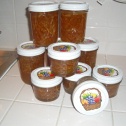
Phew! The Honeybells are no longer hanging over my head, warning me that soon they’ll be unavailable. Strange how I can wait all year for their arrival, and then work so hard to rid myself of them as quickly as possible! This year, however, I’ll be able to enjoy the taste of Honeybells in the middle of July…if I manage to keep a jar of marmalade for myself.

Jan 262006
 

Ingredients:
2 quarts of water
2.5 cups Honeybell juice (about 4 Honeybells)
3 lbs. sugar
2 - 3 inchs of fresh ginger, peeled and sliced into very thin strips
1 tsp. butter

Directions:
First, prepare the Honeybells by cutting them in half horizontally, and squeezing out all the juice through a strainer. Save the seeds and any pith that separates from the peel. Place the seeds and pith in a square of cheesecloth and save for later. Continue to juice to all four Honeybells. Pull all the loose pith from inside the squeezed Honeybells and add this to the cheesecloth. Tie the cheesecloth bundle up, leaving a strand of string to tie to the handle of the stockpot.

Slice all the Honeybell peels into thin strips. Slice the ginger into thin strips.

Place the water, Honeybell juice, Honeybell peel and half the ginger into the stockpot. Add the cheesecloth bundle to the juice, tying it to the stockpot for easy retrieval, and bring the mixture to a boil. Simmer for 2 hours.

When the peel is very soft, remove the cheesecloth bundle and let it cool. Add the sugar and the other half of the ginger to the pot. Stir this over low heat until all the sugar has dissolved. Increase the heat and bring to a boil. Don’t walk away at this point, as boiled over marmalade is not something you want to clean up (trust me!). Squeeze the cheesecloth bundle between two plates to extract all the syrupy pectin and juice and stir this into the marmalade.

Place the plates into the freezer and set the timer for 15 minutes. When the timer goes off, drop a little marmalade onto one cold plate. Place it in the fridge for a couple of minutes. If, after a minute or two, there is a skin on the marmalade when you drag your finger through it, the marmalade is finished. Otherwise, set the timer for an additional 10 minutes and repeat the process. Continue to do this until you see a skin on top of the marmalade.

Meanwhile, place all your clean, dry jars and lids into a 350 degree F oven for at least 5 minutes. When the marmalade is done, let it sit for about 15 minutes and remove the skin that has formed on the top, or stir in the butter, which will help the skin to dissolve. Fill the jars with the hot marmalade and seal. Cool in the refrigerator. Make nice labels. Give to friends. Make people happy.

Jan 192006
 

I’m a person who likes lists. That’s no surprise to those of you who know me. I use lists everyday, enjoying the sense of satisfaction that comes from being able to cross things off, getting one step closer to a goal. What’s my goal? Well, I’m not sure, and I don’t let myself wonder about that too much. I guess the goal is just to finish my list, which is futile, come to think of it, since I’m constantly adding to it.

Lately, I’ve come across several lists of “Things to Do before You Die”. Lists like these are not uncommon. There are all kinds of businesses and organizations that put out such a register. In fact, you’ll find about 140,000 such catalogues if you search Google. Usually it is just there to promote whatever product or service the business is in the habit of selling. A travel company, for instance, simply has 100 places that you, without question, must see before you die. Newspapers and magazines put out the list because people are interested in reading it, to see if they’ve accomplished the things that are deemed so important. It’s an interesting phenomenon. If a list acts as a means of telling you how close you are to a goal, then why do we aspire to cross off the tasks on the “Things to Do before You Die” inventory?

Last month, I inadvertently accomplished a task from a list of “Places to Visit before You Die”. I spent a morning at the market in Cotignac, in the South of France. Upon my return, my brother informed me that I had come one step closer to a life of fulfillment, for the Cotignac market is on a list of important places. I’m not sure who designated Cotignac market as one of the top 100 destinations of a lifetime, but my brother told me it was on The Observer’s list, and I believe him. I did wonder about the designation, however. It seems that every little French village has a market on one of the days of the week. Who knew that the little town of Cotignac would hold such importance?

Cotignac is a picturesque little town in the Var, about 15 km east of Barjols, northeast of Marseilles. The most arresting quality of the village is the wall of rock that is its northern border. The cliff wall is made of tufa rock, calcium rich and full of holes and caves. The inhabitants of the village have lived in these caves, and even built their homes into the cliff wall since before recorded history. I used to be a lover of caves and tight places as a child, and yet the thought of living in a cave of sorts is quite alarming to me now. History has it, however, that the villagers lived in these caves to protect themselves from invading enemies, and to seek refuge from political controversies, religious wars, and even epidemics. Some of the lower dwellings are still lived in today. These homes of rock overlook the town of Cotignac and its main street, which is where the market is held every Tuesday.

Indeed, Cotignac holds a very pretty and quaint market. The stalls set up sold anything you might need for an average day in Provence: cooking equipment, from knives to strainers and bottle openers, fleece shirts (quite a bargain at 5 Euros each), hand-made baskets, linens, boiled wool slippers (on my feet as I write), local olive oil, sausages, cheeses, meats, and of course, fruit and vegetables galore.

Of all the vegetables I admired in Cotignac last month (and they were beautiful enough to admire), what stands out in my head most clearly are the leeks. Leeks have an elegant quality. They are subtle and yet strong. They are a member of the lily family along with the onion, and yet they have a much more delicate flavour than their bold cousin. As they protrude from the ground, they stand tall. The structure of this soldier is well-designed – the leaves, tightly wrapped around each other, produce a stalk that does not bend over or lean, but stands straight up, announcing its presence with a quiet pride. I don’t blame it. I think if I were a vegetable, I’d be proud to be a leek. Sure, they require a good cleaning to rid them of the sand or dirt trapped inside, but what interesting person doesn’t have a little grit on the inside, out of view?

The leeks in Cotignac were slender and beautiful. As I saw them resting side by side in their basket, I could picture them on a plate - beautiful grill marks, a confident vinaigrette drizzled over top, complimenting their onion aroma. I could even imagine the fillet of fish that would sit beside them on the plate. The image of these leeks must have stayed with me, for when I returned home to Philadelphia days later, I was drawn to the leeks in my local Whole Foods. Now, Whole Foods presents its produce beautifully, but unfortunately they are still no match to an open air market in the South of France. And yet, now I can say “been there, done that”. I can cross Cotignac market off my list of “Places to Visit before You Die”, and where does it get me? Hmmm… one step closer to finishing that list. I hope it takes me, well, a lifetime to finish that list, and I do hope that is in fact a long time.

Cotignac market has made me think differently about my lists. Perhaps I need to spend a little more time enjoying what it is I’m actually doing, than simply celebrating the completion of the task. Life is, after all, what you make it. And when this life is over, I want to be able to stand tall and proud in my second life…sort of like a leek.