
The other day, my best friend participated in a team-building exercise at work. It was an “Amazing Race” of sorts which had her and her fellow employees running around Toronto on a wild goose chase, dashing into grocery stores to find specific items on the shelves, slipping into a Starbucks to order a high-impact list of “special needs” drinks from the poor unsuspecting baristas, and other similar tasks. As she told me the story of her day at the races, the one task that really grabbed my attention involved an Asian restaurant and a “horrible” drink. The teams were told to go to Saigon Palace, a Vietnamese restaurant in town, order a certain drink that has a “special” aroma, and between the four team members, drink it. Tanya couldn’t remember what it was called, but it “sounded something like dorian”. She said it was “disgusting”.
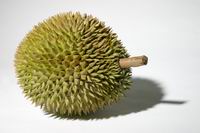 It’s been years since I’ve heard of or thought about durian. The first time I heard of this fruit (known by those who love it as “The King of Fruits”) was when I was working as a research assistant for a business professor who specialized in Southeast Asia. Of course, my professor wasn’t particularly interested in the durian, but I came across the fruit many times when conducting my research. Durian is the name of about 25 varieties of a tropical evergreen tree native to Southeast Asia. These trees bear fruit of the same name which have a hard thorny outer husk and can individually weigh 1 – 5 kg (2 – 10 pounds). Inside, there are sections of yellow curd-like flesh that surround a seed.
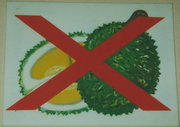 What peaked my curiosity about the fruit was the fact that its stench is apparently so powerful and unpleasant that it has been banned from public transportation systems in Singapore, as well as from many hotels and airlines. What kind of a fruit was this? Who could like and enjoy a fruit whose odor was so horrific that it was intolerable to the general public? Asia, after all, is a place where smokers abound and smoking has not been banned in public places. Could the smell of this fruit be more objectionable than sitting on a hot crowded bus with many smokers? I was fascinated. I felt like a small child, captivated by the disgusting; like a rubber-necker who must look at the terrible accident as they drive by; or like someone watching a horror flick and can’t take their eyes off the screen even though they don’t want to watch the movie anymore. I wanted to smell the disgusting.
It is now about fifteen years later and I still haven’t experienced the aroma, let alone the flavour of a durian. Mostly this has been because of lack of availability (a durian is not a fruit that you happen across in your regular grocery store), but I’d also forgotten about the durian. Out of sight, out of mind. Now, however, I am once again intrigued. It’s interesting to think that somewhere in Toronto there is a restaurant that serves a drink made with durian that smells horrible. Do they sell a lot of them? Who buys it? Only people on dares and amazing races, or regular customers too? Is the durian punishment or pleasure? I began to search for more information on the King of Fruit.
In a couple of minutes on the Internet, I found the following quotes on durians:
“It has the texture of a cold cow pat, it smells like a poorly maintained public convenience, but the taste is worse.”
“… it seems at first to smell like rotten onions…”
“… rotten onions with limburger cheese and low-tide seaweed…”
“On first tasting it I thought it like the flesh of some animal in a state of putrefaction.”
“… think clogged drains in August.”
“… the unique flavor is reminiscent of garlic, smoked ham, and rancid cheese.”
“… like eating custard in a sewer..”
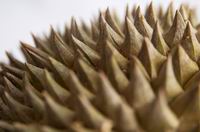 The initial investigation was not clarifying why there is any human consumption of durian at all, though my interest in experiencing the disgusting was gaining momentum. Next, I discovered that durians grow on very tall trees and fall when ripe. Put those features together with their sharp spiky husks and weight of ten pounds and you have a dangerous situation. With a little more research, I discovered that people have indeed died from durians falling on their heads, and harvesters are required to wear helmets! This fruit is sounding more and more like a mean joke of Nature. It’s Nature’s stink bomb.
Just when it was sounding unpleasant enough, I found myself saying “…but wait, there’s more” in my very best sales voice. Apparently the durian should have warnings to accompany it. People with high blood pressure are advised to avoid durian due to its richness. The fruit has “heaty” properties for most people, or causes them to sweat. Moreover, everyone is advised to avoid all alcoholic beverages when and after eating a durian because the combination of the two may create dangerous internal gasses that could result in a bursting of the bowel. Is this fruit for real? Suddenly, durian was not only disgusting, but dangerous too.
How could this be? Is the durian the Machiavellian King of Fruit, feared rather than loved? That’s when I came across a tribute to the fruit: Durian Palace. The author of this site must be the durian’s number one fan and promoter. Shunyam Nirav describes the experience of eating durian in his introduction:
Imagine the best, most delicious, and sensuous banana pudding you can imagine, add just a touch of butterscotch, vanilla, peach, pineapple, strawberry, and almond flavors, and a surprising twist of — garlic??!! Like many of life’s greatest experiences, eating durian cannot be adequately described with words. Durian has a characteristic delicious flavor, creamy texture, and tantalizing fragrance that is just… durian! — the king of fruits, Nature’s most magnificent fruit gift.
- Shunyam Nirav
Now, Nirav’s description of the fruit’s flavour does not necessarily inspire me to run out in search of a durian right now (it was the garlic that threw me!), but it does express his love of the fruit, and anyone that passionate about something deserves an audience. In fact, his website is full of very interesting information, entirely in defense of the durian. He refutes the “Western” attitudes and opinions of durian, claiming that writers disparaging durian have not tasted the fruit in its prime. Nirav also gives very interesting uses for the fruit, from using the husk to help plant seeds, to using the leaves to get rid of a headache. Looking for a durian festival? Nirav can direct you to one. On top of all that, you can check out his poetry in tribute to the durian – a must read.
So, I’d found a lover of the durian. Was he the only one? Well, Nirav may be the most expressive about it, but he is certainly not the only lover of durian. I’ve since discovered many admirers of the odorous fruit. There are several accounts of trying durian for the first time on the Internet – all favourable once past the smell. I also located a whole host of articles, including recipes, although I couldn’t find one for the durian fruit shake that Tanya tried (tried to get down, that is!). I even found Durian jam from Pacific Rim Gourmet available on Amazon.com of all places. It seems to be something you either love with abandon or detest beyond all other things.
After learning as much as I have about durian, reading of the pleasures, the pains, even the deaths, one thing seems to prevail in my mind – durian is something that one just has to try. Turns out the BBC is in agreement with me: durian came in 42nd in their top “50 Things to Eat Before You Die” list. According to their list, I have nine more items to try. I’d better get started. Tanya’s already one ahead of me!